Showing posts with label olives. Show all posts

Sunday, 17 April 2011

First sight of an artichoke

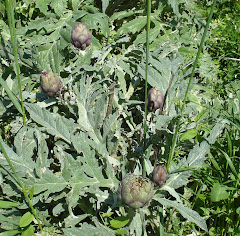
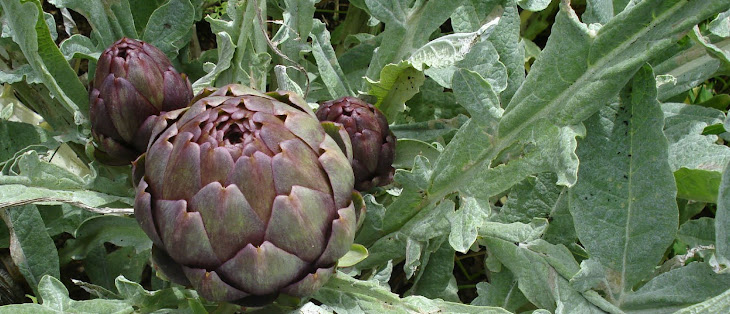
Several of the artichoke plants have small artichokes developing among their leaves, so it looks as though it may be a better crop than last year when the plants took too long to recover from the cold winter.

IMGP8843

We should be eating our own artichokes within a week or so!

Roses and olives

IMGP8848 IMGP8851
IMGP8876 IMGP8872
olive flower buds look so insignificant but the fruit will make a good harvest in the autumn, we hope.

…about to flower, while the broom and Banksiae Rose are almost over….

IMGP8888 IMGP8890

Monday, 25 October 2010

Easy for some… different stories of olive harvesting

IMGP2139

These are some of our olives, picked a couple of weeks ago, which we’ve salted and left for about ten days, with some added bay leaves and rosemary.  They were easy to harvest (with our son’s help) and no one else but us had been anywhere near the tree – it was safe.

IMGP2242 IMGP2244

Now they’re ready and yesterday we ate some of them.  We’d washed the salt off them, drained them and then added a little olive oil to coat them, and they taste very good.

Sadly, though, in Palestine olive trees are the target of conflict and dispute.  While the peace process staggers and falters, ordinary people who have their livelihoods to worry about find that their olive trees are damaged maliciously.  An article in the Guardian describes one such episode, when an eighty-year-old woman found that forty olive trees which she had planted had been destroyed:

they were now, two decades later, at their peak – the most productive of all the trees, which support 37 members of the extended family.

But . . . someone had got there before them and had chopped down the trees, leaving stumps in the ground and branches scattered about the plot. The family blame hardline Jewish settlers from the nearby Eli settlement.

Olive trees seem very special to me – because of their longevity, their ability to produce fruit and oil in dry, hot climates and their beauty.  It is tragic that they can be damaged and destroyed in this way.

There are some photographs of the olive harvest in the West Bank here.

Sunday, 26 September 2010

Blue sky, a cold north wind and ripening olives

Today was the first day it’s felt really autumnal, with a cold wind from the north drying anything that remained of the the rain we had early on Friday morning.  The sky was bright blue and the bamboo shoots waved in the breeze at the end of the garden.

IMGP0971


Another sign of autumn – the olives are beginning to ripen:

IMGP0974

Friday, 27 August 2010

Mediterranean diet

IMGP0092

Italy, Spain, Greece and Morocco have applied to the UN for world heritage status for the Mediterranean diet (although these are not the only countries bordering the Mediterranean and with similar ingredients) and a decision will be made in November.  According to an article in the Guardian this week, a spokesman for an Italian farmers’ group said: ‘Not only is this culture, but it also makes you live longer and better.’  There have been many claims for the health benefits of a Mediterranean diet, particularly for its combination of olive oil, garlic, fresh vegetables and fish.  And, of course, red wine is supposed to be healthy too, in moderation.

Here in the Languedoc we eat what would be described as a Mediterranean diet, in my case because I love all its constituents and because it is what is available locally.  For me, local food is important… so where does this leave those who don’t live in a country where aubergines and wine grapes grow?  When I was in Wales earlier this summer I found that most of the tomatoes I ate were completely tasteless and usually unripe.  Maybe in countries further north it is better to eat tasty vegetables, varieties which are suited to the climate.  Everyone can enjoy olive oil and wine, but then there is the problem of transporting food long distances, with all the environmental damage that can do.  I don’t know what the solution is for those who live further away from the Mediterranean, those people must make their own choices, all I know is that one of the great pleasures of my life is the diet that is readily available to me here.

IMGP0085 IMGP0098

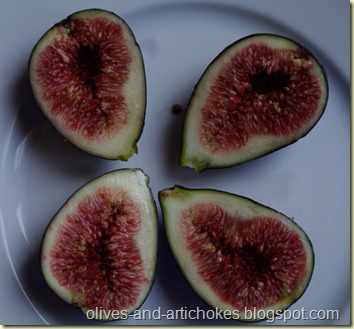
Nardello and Corno di toro peppers from the garden and figs from a friend’s tree by the river near the village, all picked this morning.

IMGP0053 IMGP0062

Lucques olives on our tree and Cardinale grapes ripening on our vine – the birds have left us a few!

Our lunch today:

IMGP0087

Terrine of joue, pig’s cheek, bought from the charcuterie stall in the village market, carrot salad (not very Mediterranean, perhaps, but it seemed to go with the terrine), cherry tomatoes from the garden, rosé wine from the Domaine des Pascales in the village and some of the figs we picked this morning.

Friday, 13 August 2010

It’s good to be home

DSC05631


We’re home again after three weeks away. We’d planned just a one-week break but had to leave unexpectedly a fortnight earlier because of a sudden death in the family, so after a sad time it’s very cheering to come home to a wonderful harvest of aubergines, peppers and tomatoes, thanks to our neighbour who watered the garden for us. We’ve got a busy weekend ahead now making tomato puree to store for the winter because the Roma tomatoes are just waiting to be picked.


DSC05626 DSC05629 DSC05640

and two delicious salads

DSC05644 DSC05646-1

A Greek salad, left, made with cucumber, tomatoes, peppers, garlic and onions from the garden and feta cheese and black olives. On the right, tomato, Red Marconi pepper and basil salad.

Monday, 14 June 2010

Sunday, 30 May 2010

Biodiversity in Haiti

I know everyone wants to help the shattered lives and economy of Haiti following the earthquake there earlier this year, but I’m afraid that, having been alerted to this by Gaiashope, I find it hard to trust the motives of Monsanto in ‘donating’ corn and tomato seeds to the farmers on the island.  According to the Food Freedom website, Chavannes Jean-Baptiste, spokesperson for the peasant farmers’ movement, has called Monsanto’s involvement “a very strong attack on small agriculture, on farmers, on biodiversity, on Creole seeds…, and on what is left [of] our environment in Haiti”.  Monsanto have responded to criticism by saying that they are not supplying genetically modified seeds.  However, Food Freedom reports:

The hybrid corn seeds Monsanto has donated to Haiti are treated with the fungicide Maxim XO, and the calypso tomato seeds are treated with thiram.  Thiram belongs to a highly toxic class of chemicals called ethylene bisdithiocarbamates (EBDCs). Results of tests of EBDCs on mice and rats caused concern to the U.S. Environmental Protection Agency (EPA), which then ordered a special review. The EPA determined that EBDC-treated plants are so dangerous to agricultural workers that they must wear special protective clothing when handling them.

It’s hard to imagine that in the difficult circumstances following the earthquake farmers will have the training and protective clothing to handle these seeds.  Also, hybrid seeds are not suitable for seed saving, so the farmers will become dependent on Monsanto for future years’ seeds, which presumably will have to be paid for.  As one Haitian farmer told Food Freedom: “People in the U.S. need to help us produce, not give us food and seeds.  They’re ruining our chance to support ourselves.”   Haitian farmers have threatened to burn the seeds when they arrive.  I hope that they can be given seeds by more philanthropic organisations, so that they can re-establish their agriculture without the influence of a large commercial organisation which is known all over the world for trying to make profits out of small farmers.

First garlic bulb and a tiny first aubergine

DSC03859 DSC03864 DSC03847

I pulled up our first garlic bulb this morning – it’s not very big, but it’s a lot bigger than the ones we’ve grown before!  We’ll leave the tiny aubergine to get bigger than that.  And the Luque olive tree is covered with flowers like these – a good sign for the autumn crop.

Monday, 10 May 2010

Update after the rain

We’ve had several more days of rain so the garden is well watered, but we could do with some sunshine now to encourage the plants to grow.

A nice surprise

DSC03533 Our artichoke plants were all badly affected by the cold weather we had in March, which came just as the plants were beginning to grow again after the freezing temperatures we had in January.  This time last year we were picking artichokes, but this year I was afraid we weren’t going to get any at all.  So I was very pleased today to see that two small artichokes had appeared – after all, I didn’t want to have to rename the blog!

And olives ….

well, flower buds at least – our little Lucque tree is covered in buds.

DSC03541


We’ve been preparing the beds for the pepper plants and deciding how we’re going to fit them all in.  We have about 40 plants altogether, not counting chilli peppers, as this year we’ve managed to get almost all of them to grow well.  We’ll probably plant them out tomorrow and I’ll take some photos then.

Replacing the beans the birds had eaten

DSC03538 So many of our haricot and alubia bean plants had failed to appear or been eaten by birds that I germinated some in seed trays in the house.  Today we planted them out in the gaps, with some Planeta climbing mangetout beans as well.  I made a string of ‘bunting’ with strips of a plastic bag which I hope will deter the birds.

Roses and a butterfly on the wild thyme

DSC03535
There’s borage growing as a weed among the roses, but I think it looks good there.
DSC03544

Asparagus

The wild asparagus is almost over now but yesterday we bought some cultivated asparagus from a stall in a fair in the village.  It hadn’t come far, just 5 km from a nearby village, and it was delicious.  We had some of it with a vinaigrette dressing and crusty Aveyronnais bread, and also made an asparagus and goats’ cheese tart.

DSC03516 DSC03514

Saturday, 17 April 2010

A Catalan break

I seem to have become a ‘weekend blogger’ – I don’t usually leave a gap of nearly a week between posts, but I have couple of excuses: first, I’ve been unable to connect to the internet for more than 15 minutes at a time since last Sunday night, something which has been resolved today by the installation of a new ‘Livebox’. And secondly, I’ve been away, staying for a couple of days in Banyuls-sur-Mer in the French part of Catalunya.

Banyuls is famous for its vin doux, a naturally sweet wine produced thanks to the amount of strong sunshine in that area. Squeezed between the Pyrenees and the rocky Côte Vermeille coast, the vines are grown in terraces anywhere on the slopes where there is space to make it worthwhile working the ground.

DSC02982
The vines were only just beginning to sprout this season’s bright green leaves, but these pictures show how close to the sea and the mountains the vineyards are.
DSC02998

The terraces are walled with local stone, with drainage channels leading down between them, and are sometimes wide enough for only two rows of vines.

DSC03008 DSC03018
DSC03023 DSC03015

The three variations of Banyuls – red, white and ambré (with added caramelised sugar to give a golden colour) – are all delicious apéritifs and can also be used in cooking. The chef at the restaurant at the Hotel des Elmes where we stayed was expert at this – two of the wonderful dishes we tasted were scallops and Catalan blood sausage with a reduction of Banyuls, and escalope of foie gras with a chocolate and Banyuls sauce. There’s more information about Banyuls on this website.

On the way home we stopped near Millas at the Moulin du Mas St Pierre where Monique and Joseph Planes decided some years ago to change their fruit farm into an olive farm. They now have 30,000 olive trees all of the Arbequine (Arbequina as it’s called in Spain) variety grown closely in rows, rather like the fruit trees in neighbouring farms. These Arbequine olives, grown mostly in Catalunya and Spain, are very small and Monsieur Planes told us that this gives them one great advantage over other varieties: the olive fly does not attack them because there isn’t enough flesh around the stone for it to burrow into the olive. This means that they have been able achieve organic status for all their production as they don’t need to use chemicals on the trees. There is a very modern mill at the farm and huge tanks where the oil is stored at a constant temperature of 18 degrees C to preserve the flavour of the oil. As always when we visit the premises of a producer of good food or wine, it was a delight to talk to someone as impassioned about his products as Monsieur Planes and, of course, to buy some of his wonderful oil to bring home. His passion and hard work have been rewarded, too, with a gold medal this year at the Concours Général Agricole in Paris. Madame Planes travels around the world – as far as Shanghai recently – to food fairs, so that now their oil is sold in many countries and even, M. Planes told us proudly, in Harrods in London.

DSC03027 DSC03028

Thursday, 31 December 2009

The Camargue and an olive mill

We treated ourselves to a couple of days in the Camargue, staying at Aigues-Mortes, a fortified town which was a port until it silted up and the sea moved out to Le Grau du Roi, about 6 kilometres away. We were hoping to see flamingos, and we did but the weather was so grey and misty that I couldn’t get good photographs of them.

DSC00866

The canal at Aigues-Mortes

DSC00880

A gloomy sky at le Grau du Roi

DSC00899 DSC00903

Bulls at a manade, where they are raised for the courses camargaises, the non-violent form of bull-fighting in which young men attempt to retrieve a rosette or ribbon from the head of a bull – more dangerous for the man than the bull!

DSC00906


An egret perched on the back of a horse.


Domaine d’Oulivie

On a detour on our way back from the Camargue, up a rough track near St Gely du Fesc (north-west of Montpellier) we found this olive mill, museum and shop surrounded by a huge grove of lovely mature olive trees.

DSC00908 DSC00914
DSC00919 DSC00921
DSC00924 DSC00910

We tasted the range of olive oils produced here and bought bottles of two: the single-variety Lucque oil and a special oil made by milling the olives with thyme and rosemary (rather than infusing the herbs after the oil is made). Wonderful flavours with which to end the year!

A l’an que ven! (Occitan for see you next year!)