Showing posts with label asparagus. Show all posts

Monday, 10 May 2010

Update after the rain

We’ve had several more days of rain so the garden is well watered, but we could do with some sunshine now to encourage the plants to grow.

A nice surprise

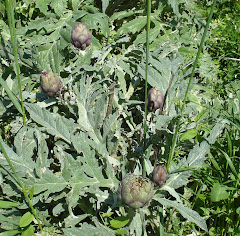
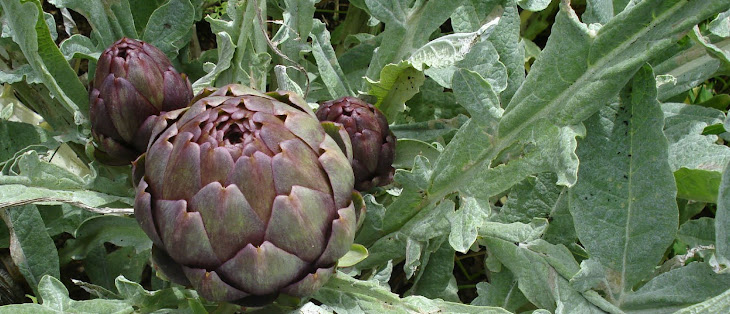
DSC03533 Our artichoke plants were all badly affected by the cold weather we had in March, which came just as the plants were beginning to grow again after the freezing temperatures we had in January.  This time last year we were picking artichokes, but this year I was afraid we weren’t going to get any at all.  So I was very pleased today to see that two small artichokes had appeared – after all, I didn’t want to have to rename the blog!

And olives ….

well, flower buds at least – our little Lucque tree is covered in buds.

DSC03541


We’ve been preparing the beds for the pepper plants and deciding how we’re going to fit them all in.  We have about 40 plants altogether, not counting chilli peppers, as this year we’ve managed to get almost all of them to grow well.  We’ll probably plant them out tomorrow and I’ll take some photos then.

Replacing the beans the birds had eaten

DSC03538 So many of our haricot and alubia bean plants had failed to appear or been eaten by birds that I germinated some in seed trays in the house.  Today we planted them out in the gaps, with some Planeta climbing mangetout beans as well.  I made a string of ‘bunting’ with strips of a plastic bag which I hope will deter the birds.

Roses and a butterfly on the wild thyme

DSC03535
There’s borage growing as a weed among the roses, but I think it looks good there.
DSC03544

Asparagus

The wild asparagus is almost over now but yesterday we bought some cultivated asparagus from a stall in a fair in the village.  It hadn’t come far, just 5 km from a nearby village, and it was delicious.  We had some of it with a vinaigrette dressing and crusty Aveyronnais bread, and also made an asparagus and goats’ cheese tart.

DSC03516 DSC03514

Saturday, 27 March 2010

Spring flowers, Lezignan onions and wild asparagus

DSC02406

There’s a partridge hiding in the shadow under these olive trees, and a colourful mix of grape hyacinths and dandelions in the foreground.

It’s the time for planting oignons de Lézignan, the variety of sweet onions which come from the village of Lézignan la Cèbe near Pézenas (ceba is the Occitan word for onion and the village has taken the French version of this word as part of its name).  I wrote about this last year on this blog.  Last year our neighbour went to buy them for us from Monsieur Lucas, one of several producers in the village, the one he says is the best, and this year it was our turn to go. 

DSC02409 DSC02412
M. Lucas has a website, advertised in the photo (left) for orders by post:
plantsdoignons.free.fr 
DSC02412-1
I liked the onion sign attached to a rubbish bin!

As M. Lucas’s website tells us: ‘La Cébe des Lézignan es douça coumo lou pan’ (Occitan for ‘Lézignan onions are sweet as bread’.  Last year we enjoyed them raw in salads until the grew bigger and stronger-flavoured when we barbecued them and cooked them in sauces.

Lo Jardinièr planted them today in a double row, cutting off the tops of the leaves and putting them not too deep and lying slightly against the earth beside them.  Once they settle into the ground they straighten themselves up.

DSC02431 DSC02436
DSC02440 DSC02441

While he was doing that, I sowed the first haricot beans of the season.  According to one of our friends and gardening neighbours, St Joseph’s Day, 19 March, is the time to start sowing haricot beans, but although we’d prepared the ground for one reason or another I didn’t get round to sowing them until today, which according to the Gardener’s calendar is a good phase of the moon for them.

And it’s asparagus time!

Looking back at my blog posts for this time last year, I noticed that when I wrote about Lézignan onions I also wrote about wild asparagus.  So, it’s not surprising that today we’ve picked the first wild asparagus of this spring.  We didn’t have to go far – when we first took over our garden it had been unused for many years, so wild plants had taken over.  When we found wild asparagus plants we either moved them to somewhere convenient or left them where they were in some of the wilder areas of the plot.  Today we picked a bunch which made a tasty first course for our lunch, cooked in boiling water for about 10 minutes and served very simply with olive oil, chopped garlic, salt and pepper and bread.  They have all the flavour of fresh cultivated asparagus but intensely concentrated into thinner spears – wonderful!

DSC02465 DSC02481

Jasmine flowers too …

DSC02438


The jasmine we planted a couple of years ago is flowering for the first time.

Friday, 17 April 2009

Some flowers in the garrigue / Quelques fleurs en garrigue

It was a lovely clear sunny morning and from Montesquieu we could see Mont Canigou and the Pyrenees, the peaks still covered with snow.  / Il a fait beau et clair ce matin et de Montesquieu on a pu voir le Mont Canigou et les Pyrénées, leurs sommets couverts de neige.

canigou from montesquieu_1

Olive trees live for centuries and often the original tree has died while new young trees have grown up around the beautiful shapes of the hollow centre.  / Les oliviers vivent pour plusiers siècles et souvent l'arbre original est mort et des arbres nouveaux ont poussé autour les formes belles du centre creux.

olive trunk 1_1_1 olive trunk 2_1_1
olive trunk 3_1_1 olive leaves_1_1

In the garrigue, the scrubby vegetation that grows on uncultivated hills, this is the time of year when the plants flower before dying back during the dry summer.  /  Dans le garrigue, la végétation broussailleuse qui pousse sur les collines, les plantes fleurissent à cette saison avant de perdre leurs feuilles et leurs tiges pendant la sécheresse d'été.

I find the website http://www.maltawildplants.com/ very helpful when I'm trying to identify Mediterranean plants.  It is an incredible work by one man, Stephen Mifsud, who is cataloguing and describing the flowering plants which grow in Malta.  Many of these are common to the area all around the Mediterranean, so it is an extremely useful data base.

Today we saw / aujourd'hui on a vu:

cistus albidus   wild asparagus_1_1 cistus close up_1 Cistus albidus
clustered sulla_1_1 Clustered sulla, Hedysarum glomeratum Lathyrus clymenum_1_1
Crimson pea, Lathyrus clymenum
thyme   wild asparagus_1_1

Thyme and wild asparagus growing together.

Le thym et les asperges sauvages ensemble.
asphodelus albus_1_1 asphodel
Asphodelus albus
aphyllanthes monspeliensis_1_1 aphyllanthes close up_1
Aphyllanthes monspeliensis

new salad box_1_1 Back at the garden, Lo Jardinièr finished making a new raised bed and planted out lettuce plants our nighbour had given us.  He made a wooden frame with some cast-off planks, put it on a patch of rough ground we haven't used before and filled it with a mixture of half compost and half soil.

Lo Jardinièr a construit une parterre pour les salades.

Saturday, 21 March 2009

Asparagus and sweet onions / Les asperges et les oignons de Lézignan

Onions from Lézignan-la-Cèbe are a local speciality.  They are sweet onions from a small village near Pézenas which in 1615 added 'la Cèbe' to its name, from the Occitan word for onion - ceba. In Occitan there is even a special verb meaning 'to plant onions' - cebejar.  In spring the onion growers in the village sell young plants at the roadside for replanting.  Our neighbour went there and brought 100 plants for us.

L'oignon doux de Lézignan-la-Cèbe est une spécialité de ce village près de Pézenas.  Le village a ajouté 'la Cèbe' à son nom en 1615 en honneur.  Ce mot vient du mot occitan ceba (oignon).  En printemps les cultivateurs d'oignons vendent les jeunes plantes au bord de la route.  Notre voisin y est allé et il nous en a apporté 100 plants.

lezignan onions_1_1 lezignan onions - planting_1_1_1

It was difficult to find space for 100 onions we hadn't planned for, but we've put them in a double row alongside the potatoes.

asparagus salad 1_1_1 We've been lucky this week - we were given some more wild asparagus too.  We cooked the spears for a couple of minutes in boiling water, let them cool and dressed them with olive oil and a little lemon juice to eat as a salad.  They were delicious - a concentrated flavour of asparagus but with the added 'herbyness' of the garrigue. / On a préparé une salade d'asperges sauvages: cuire les asperges dans l'eau bouillante pour 2 minutes et puis ajouter un peu d'huile d'olive et de jus de citron.  Elles étaient delicieuses avec un gout concentré d'asperge et des herbes de la garrigue.

And a rustic wall / et un mur rustique

Lo Jardinièr has started to make a stone wall to protect our rose bushes from the north wind, using pieces of stone he's collected.  / Lo Jardinièr a commencé la construction d'un mur en pierres pour protéger nos rosiers du vent du nord, en utilisant des pierres qu'il a ramassé.

rose wall 1_1_1_1
the first row of stones in a trench ....
rose wall 3_1_1 choosing the right stones ... rose wall 2_1_1_1 work in progress.