Saturday, 7 May 2011

Apples and cherries

We’ve never before had so many apples as there are on our tree this year.  It almost makes up for the poor apricot crop (I can see two fruits on that tree), but I’d much prefer to have apricots instead.  It’s exciting that our small wild cherry tree, planted as a sucker given to us by our neighbour about two and a half years ago, is bearing its first fruit (below, right).

IMGP9538 IMGP9531 IMGP9503

And those irises again, framing some orange poppies:

IMGP9509

Wednesday, 4 May 2011

Artichokes and a lot of spring flowers

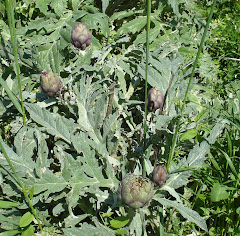
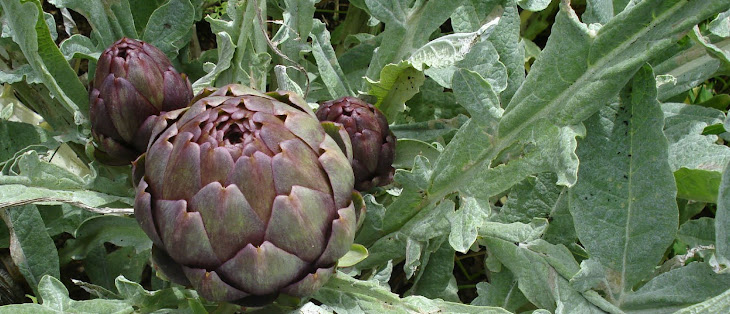
I picked three more artichokes this morning, making 9 in all this year, so the plants are doing much better than they did last year and there are plenty more still growing.

IMGP9416 IMGP9418

It’s the most colourful time of the year in the garden and in the garrigue because all the plants flower now before dying down again when the weather gets too hot and dry for them from June onwards.

IMGP9374 IMGP9404 Cistus (left), poppies (above) and irises (right). IMGP9388

And because the irises look so lovely now and won’t last for long I took a lot of photos of them this morning:

IMGP9386 IMGP9394
IMGP9387 IMGP9397

Monday, 2 May 2011

Planting out aubergines and finding a green lizard

We’ve planted out about a dozen aubergine plants our neighbour gave us – six of them next to a row of peppers on the left below.  We usually grow the grafted plants, bought from a garden centre, because they produce so many more aubergines than the ordinary plants, but this year we’ll try these, as well as a few grafted ones.  The Greek maize I planted out a couple of weeks ago is doing well (on the right below).

IMGP9309 IMGP9321
Sweet corn (maize) and a row of lettuce.

We also planted a row of chard, also given to us by our neighbour, next to the two rows of haricot beans which are growing quite well.  I picked the rest of last year’s chard today as it was going to seed, and we ate it this evening with pasta and cured ham.

IMGP9320

Our ‘big’ iris has started to flower (left below), later but more spectacularly than our white and mauve irises, and the red salvia was attracting a few bees (right).

IMGP9307 IMGP9304


And the green lizard under the olive tree

IMGP9280 IMGP9283

They’re much more shy than the brown wall lizards, so I was lucky to catch this one on camera!

IMGP9247 Our garlic is growing quite tall, but I don’t think it will ever be as good as the garlic I bought from this stall in Pézenas market on Saturday.  It’s very fresh and tastes wonderful chopped raw onto salads and other vegetable dishes.

And home to lunch….

IMGP9331 After working in the garden this morning we came home to a lunch of aubergine puréed with olive oil, garlic and oregano, some broad beans straight from the garden cooked with cured ham, and goats’ cheese from Roujan with thyme from the garden and olive oil that was milled in the village from olives from Servian, only about 10 kilometres away – all local, fresh and delicious!

Friday, 29 April 2011

April in the garden

It’s the greenest time of the year, after the spring rain and before the summer drought, so the weeds as well as the flowers and vegetables seem to grow visibly from day to day.  We’ve eaten our first artichokes – thinly sliced hearts sautéed in olive oil until the edges of the leaves were browned and the centres were soft.  All they need then is a little salt and pepper – it’s one of my favourite ways of eating artichokes.

The cistus flowers are out now, each lasting only a day but being replaced by others the next day.  This cricket was resting on one of them:

IMGP9193

Friday, 22 April 2011

Planting out the first tomatoes

IMGP8963 IMGP8965
We’ve planted out 12 Roma plants (left) and 18 Languedocian plants so far….many more still waiting.
IMGP8962

IMGP8958 IMGP8971 IMGP8975

The cistus flowers (left) each last only a day before the petals fall, but there are plenty of buds in the garden and in the wild in the garrigue.  The irises last a bit longer – these (centre) are in our garden, but they’re often planted along the edges of vineyards too.  The orange poppy (right) is in the garden too, and all the rough patches of ground between the vineyards are covered with the flowers of the red, wild ones.

Sunday, 17 April 2011

First sight of an artichoke

Several of the artichoke plants have small artichokes developing among their leaves, so it looks as though it may be a better crop than last year when the plants took too long to recover from the cold winter.

IMGP8843

We should be eating our own artichokes within a week or so!

Roses and olives

IMGP8848 IMGP8851
IMGP8876 IMGP8872
olive flower buds look so insignificant but the fruit will make a good harvest in the autumn, we hope.

…about to flower, while the broom and Banksiae Rose are almost over….

IMGP8888 IMGP8890

Tuesday, 12 April 2011

Planting out the maize and lettuce

I was sent 10 Greek maize (sweetcorn) seeds by Gaia’s Hope and they all germinated.  They’re a variety that are very drought resistant, so I hope they’ll do well here.  Today we planted them out, as well as some lettuce plants that our neighbour gave us.

IMGP8685 IMGP8687

I sowed the seeds in compost in toilet rolls (left above) and soon after they germinated they had huge roots and were outgrowing the tubes.  I took the cardboard tubes off before putting the plants in the ground in case they dried out too much and stopped the roots growing through properly. 

Spring flowers and an alien appearance

IMGP8693 IMGP8695 IMGP8697

The first cistus flowers are starting to appear – this one (above, left) is by the path to our garden on a neighbour’s plot.  The Muscat d’Hambourg table grape vine has tiny flower buds on it (centre).  And work continues on the housing development next to the garden, with the incongruous appearance of a theodolite above an ancient dry stone wall (right).

IMGP8682 IMGP8700

A green salad (left) made from leaves from the garden – lettuce, spinach, broad bean, rocket, celery – with slices of cou farci we made with one of the duck necks we brought back from the Gers.  I mixed sausage meat (100 % pork) with raisins soaked in white wine, salt, and pepper, and used it to stuff the skin of the duck neck.  The stuffed necks were then added to the pan with all the duck fat and the legs to make confit, and simmered gently for two and a half hours.  They can then be stored in a cool place covered with fat for weeks, or even months, although I don’t think ours will last very long.  The leeks (in the right) are some remaining from our very poor crop this year.  They were very tasty, though, cooked in white wine, left to cool and eaten as a first course with salt, pepper and a vinaigrette dressing.