Showing posts with label Bouzigues. Show all posts

Saturday, 11 September 2010

Preparing for winter, while the summer harvest goes on

IMGP0511

The tomatoes are coming to an end, and some of our gardening neighbours have already uprooted their plants, resigned to its being a bad year for them.  We’re picking and eating peppers every day and we’re pleased we planted so many different varieties which all have their own characteristics: the ones on the left of the photo above are Corno di Toro which are good for stuffing; there’s a spicy Kolaska next to the aubergine and some Longues des Landes on the right – they’re both good varieties for grilling on the barbecue.  In the centre there are a few red chillies.

IMGP0538-1

For lunch today we grilled some green peppers and the aubergine on the barbecue.  I then skinned the peppers, which is very easy when they’ve been grilled and the outer skin has blackened.  I made a salad with them, some oregano and chopped garlic, goats’ cheeses from Mas Rolland and some cherry tomatoes, added a bit of salt and some olive oil and served them with fresh Aveyronnais bread.

IMGP0504

We picked another five or six kilos of figs this morning and made some more jam.  The recipe is very simple: for each 600 gm of figs, chopped and put in a large pan, I added 400 gm sugar and the juice of half a lemon.  I brought them all to the boil and simmered until the jam thickened and began to set when a spoonful was put on to a cool saucer.  Then bottle in sterilised jars.  We now have twenty jars of mixed, green or black fig jam, so we know we’ll have something for winter breakfasts.

IMGP0543 IMGP0545


Mussels for supper

IMGP0548-1


As usual on a Saturday morning, the coquillage van from Bouzigues came to the village, so we bought a kilo of mussels and ate them this evening in a sauce made with onions, garlic, wild fennel, lardons, white wine and crème fraiche.  And as usual they were delicious. 

Thursday, 13 May 2010

Brasucade de moules

We’re very lucky that the coquillage (shellfish) van comes to the village twice a week bringing sustainably produced and delicious shellfish from Bouzigues on the Etang de Thau, a salt-water lagoon only 30 or so kilometres from here.  One of our favourite ways of eating mussels is to cook them on the barbecue in a big open pan – we use a paella pan or a Spanish sartén honda, both of which are available very cheaply in a local discount store. 

DSC03599

Today I lightly sautéed a couple of sliced garlic cloves, some sprigs of savoury and rosemary, some lardons fumés (smoked bacon pieces) and a chopped dried Espelette pepper in olive oil over the flames and then left them to infuse while we cooked some whole Spanish sweet onions which I’d just pulled out of the ground.  When the onions were done and while we were eating them as a first course, the mussels were left to open and cook over the fire.

DSC03589 DSC03592
DSC03605 DSC03596

When the mussels are cooked we just put the pan in the middle of the table for people to share, with a sprinkling of chopped fresh garlic, a squeeze of lemon juice and some crusty bread.  And a glass or two of rosé wine from the Domaine des Pascales in the village.  The sun even came out for an hour or so while we were eating!

Spring flowers and leaves

DSC03570 DSC03575
DSC03581 DSC03587

The white cistus is now in flower and one of its flowers had a yellow butterfly on it.  The mangetout peas are flowering too – such beautiful petals, as lovely as sweet peas but with the advantage of pods to eat later.  Vines have insignificant flowers so this is one plant where the leaves are more impressive, especially when the sun casts shadows of one leaf upon another.

Planting out the peppers

DSC03616

We did some work too, and planted out most of our pepper plants.  There are a few more to do tomorrow and some which we want to grow in pots outside the house.

Saturday, 14 March 2009

Warm enough for a lizard / Assez chaud pour un lézard

lizard_1 Suddenly it's spring and the lizards are out in the sun ...


Tout à coup, c'est le printemps et les lézards sortent au soleil ...


Garden Bloggers' Bloom Day

Last month I was away on the 15th so I missed it, and we didn't have many blooms in the garden anyway.  This month is much more colourful:

Le mois dernier je n'étais pas chez moi le 15, et il n'y avait pas des fleurs au jardin.  Aujourd'hui il y a beaucoup plus de couleur:

anemone1_1_1
anemones ...
apricot blossom_1_1
apricot blossom / fleurs d'abricotier ...
aubretia1_1_1
aubretia ...
daffodils2_1 
daffodils / les narcisses ....
grape hyacinth1_1_1_1
and grape hyacinths / et les muscaris.
grape hyacinth2_1_1_1

Garden Bloggers' Bloom Day is hosted by Carol at May Dreams Gardens.

Moules gratinées

On Friday at an otherwise excellent restaurant in Agde, I ordered moules gratinées and was shocked to find when they arrived that they were huge, green-shelled creatures which I knew don't grow near here.  I asked the waiter and he said that they came from New Zealand!  Although he added that they used local mussels for moules marinières.  Agde is only about 10 km from the nearest mussel beds in the Bassin de Thau.  These New Zealand mussels had suffered from their long journey and months in the freezer - they were tough and tasteless.  How sad, because apart from this the food was good at this family-run restaurant on the quayside, where the woman chef came to our table and explained her ratatouille recipe in great detail - and it was the best ratatouille we'd ever had in a restaurant, as good as we make at home!

Vendredi j'ai commandé des moules gratinées dans un restaurant à Agde et j'ai été étonnée de trouver qu'elles sont des grandes moules au coquilles vertes qui ne viennent pas d'ici.  Elles sont venues de la Nouvelle-Zélande.  Agde n'est que 10 kilometres du Bassin de Thau.  Cettes moules ont souffert de leur voyage long et les mois qu'elles ont passé au congelateur.

At home tonight, I made moules gratinées (garlic, parsley, white wine, bread crumbs, grated cheese and a little paprika) with mussels from Bouzigues and they were delicious:

Chez nous ce soir j'ai fait les moules gratinées - les moules de Bouzigues à l'ail, persil, vin blanc, chapelure, fromage rapé et un peu de piment doux - et elles sont delicieuses:

moules gratinees 2_1_1

Followed by Lo Jardinièr's chard and goats' cheese tart:

chard   goats' cheese tart_1_1

In the garden / Au jardin

celery_1_1_1 new artichoke_1_1
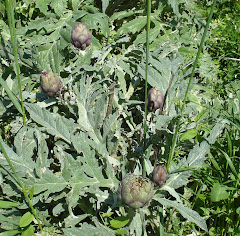
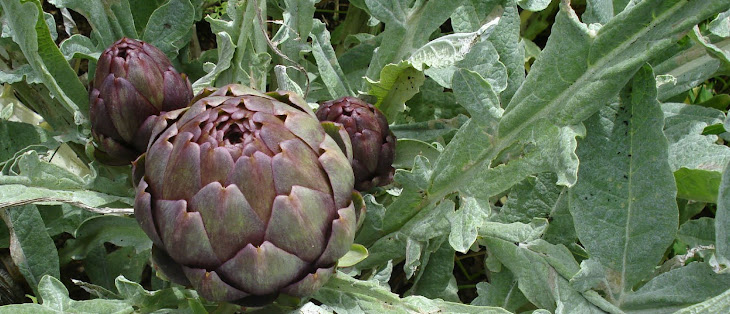
We planted out 10 celery plants from seed given to us by Kate.  I sowed the seed in October and they have grown very slowly on the windowsill through the cold weather.  They're doing well now, though.  Thanks, Kate!  The artichoke plant on the right is supposed to be the same variety as its bigger neighbour - Violet de Provence.  I can't remember whether the others had similar smooth-edged leaves when they were small.

Thursday, 22 January 2009

It's Thursday, so it must be oysters / les huitres

oysters2_1_1

A sustainable supper

We're so lucky here in Gabian that the coquillage van comes to the village twice a week bringing fresh shellfish from Bouziques.  Oysters seem to be one of the best foods we can get from the environmental point of view ... and they're delicious and very good value.

In the Guardian newspaper last Saturday Hugh Fearnley-Whittingstall was encouraging readers to eat oysters, raw or cooked.  He gave some recipes - including one for oyster and chard fritters, which I want to make sometime soon, and another for oysters with chorizo.  This recipe was for six oysters to serve six people as a starter - well, here in the Midi we eat oysters in larger quantities than that, but the recipe sounded very tempting.  I had a nice chunk of chorizo which I'd bought from the charcutier at the market yesterday and realised that I could combine this with one of my favourite ways with oysters - huitres gratinées, putting them under the grill with white wine and cheese.

We started with some of our leeks, and onions, sautéed in olive oil and then served with shavings of parmesan.

leeks_1 leeks   parmesan_1_2_1

Les poireaux sautés aux oignons et l'huile d'olive.  Servir au parmesan.

Oysters gratinées with chorizo / Huitres gratinées au chorizo

oysters   chorizo_1_1

We added chopped garlic, olive oil, white wine and grated Cantal cheese to the oysters in their shells and put them under the grill for about 5 minutes until the cheese began to brown.  In the meantime we cooked the diced chorizo in olive oil, then served it with the oysters and poured the spicy oil from the frying pan over the oysters.

We finished this Thursday evening feast with some of the lovely Spanish clementines which are in all the local shops and markets at the moment.

clementines_1

We felt we deserved all of this after a few hours' hard work earlier on, spreading another trailer-load of goat manure on the garden.

Sunday, 14 December 2008

More mussels and a precocious cauliflower / Encore de moules et un chou-fleur précoce

I've been thinking about the mussels we ate last Thursday evening, bought from one of the two vans a week which bring shellfish to Gabian.  Mussels and oysters from the Bassin de Thau, a salt-water lagoon between Sète and Agde, seem to me to be one of the most sustainable foods available. 

oyster beds_1
Mussel and oyster beds near Bouzigues
oysterbeds_1
Bassin de Thau


Je pense que les huitres et les moules du Bassin de Thau, une lagune entre Sète et Agde, sont très durable.

The shellfish are farmed and so do not deplete any of the sea's natural stocks. The industry is a major employer in the area and is good for the environment because keeping the water clean and unpolluted is in the interests of the producers, who have to add an extra cleaning process to their production on the rare occasions when the water is found to be polluted.  As far as I can tell, the carbon footprint from the mussels lies mainly in the fuel used to bring them the 30 kilometres or so to Gabian.

J'écrirai plus sur la production de coquillages dans le Bassin de Thau bientôt, mais pour le moment je vous donne la recette du plat que j'ai fait jeudi soir:

I'll write more about the shellfish production in the Bassin de Thau soon, but in the meantime here's the recipe for the dish I made on Thursday:

Stuffed mussels with muscat / moules farcies au muscat

mussels 1_1_1

Clean a kilo of mussels and cook in boiling water for a few minutes until the shells have opened.  Remove the half of each shell without a mussel and put the shell-halves with mussels in an oven-proof dish.  Cover the mussels with a mixture of 100 gm breadcrumbs, 3 finely chopped garlic cloves, a bunch of parsley and thyme chopped, salt and pepper.  Add a teaspoonful of muscat or other sweet wine to each shell and drizzle olive oil over them all.  Put under a hot grill for about 5-10 minutes until the breadcrumbs are crispy.  Serve with a slice of lemon. 

La recette sera sur le blog mediterranean-cuisine.

mussels 2_1_1

This was the first time I'd made this dish and it was delicious - I'll be making it again soon!

An early cauliflower

cauliflower_1_1_1

We didn't expect to have cauliflowers for another couple of months, but this small one suddenly appeared last week.  Yesterday it had begun to look slightly yellow and we thought it wouldn't grow any bigger so we brought it home to cook.  As you can see in the picture, it was only about 10 cm across the head.

Lo Jardinièr quartered it and steamed it, then served it with cumin seeds and chopped garlic which had been very lightly sautéd in olive oil.  It was very good - but we hope the others will be bigger!

cauliflower3_1_1

Friday, 7 March 2008

New plants and oysters

The plants in our spring kitchen window - a jumble of daffodils, cyclamen and pansies which have brightened the view for weeks - are coming to an end now, so in yesterday's cold north tramontane wind and bright sunshine we went to buy plants to put in pots by the front door. We're lucky to be near Mèze where Pépinière Filippi specialises in plants for a dry climate. Unlike some garden centres which tempt us with plants which need too much water and would grow better in a more northern climate, Filippi suggests that we fill our gardens with plants which thrive here. If you can't get to Mèze, their website www.jardin-sec.com gives a lot of very useful information if you understand French. Even if you don't, the plant names are in Latin and the pictures are excellent. We bought a Gazania rigens, a Lantana montevedensis and a Rosmarinus officinalis var. repens, all recommended for growing in containers. On the way back we stopped at De la Terre à la Terre in Montagnac - another good place for Mediterranean gardeners, although it concentrates more on trees, olives, citrus and palms. We bought this unlabelled shrub with pretty pink flowers:

Does anyone know what it is?


Oyster beds near Bouzigues

We made a detour to Bouzigues for lunch. Bouzigues is an oyster village - the whole place is devoted to producing and selling oysters, with a few other shell fish - clams, sea urchins and mussels. There's a line of cafés and restaurants along the shore of the Bassin de Thau, a salt water lagoon separated from the sea by a thin strip of land. We went to our favourite, Chez la Tchèpe.

You sit at plastic tables in the sun, choose your oysters from crates on the counter and eat them with a glass of Picpoul while you look out at the beds where the oysters grew, only a couple of hundred metres away. Picpoul is the white wine made from grapes grown in this small area between Pézenas, Bouzigues and the sea, whose slight piquancy makes it the perfect accompaniment for sea food.

Choose your lunch . . .