Showing posts with label beans. Show all posts

Sunday, 11 July 2010

La Fête vigneronne at Faugères

Sunday morning wine tasting in a village of balconies and bunting:

DSC04970 DSC04976-1 DSC04969


DSC04994

A theatrical entrance to the old village whose narrow streets were filled with the stalls of wine producers, cheese makers, biscuit, cake and honey sellers, charcuterie producers and throngs of people tasting all this in the heat.  We found and bought some familiar produce – goats’ cheese from Mas Rolland – and tasted wines we’d not tasted before from Domaine du Météore at Cabrerolles and  Domaine Alquier at Faugères and bought rosé from Domaine Ballicioni at Autignac and Chateau des Peyregrandes at Roquessels (next door to Chateau des Adouzes where we buy wine regularly, but we’ve never ventured here before).  A completely new discovery, to us, was the Saffron syrup from the Tarn region of south-western France, which can be added to white wine to make Saffron kir and can also be used in cooking gambas or duck.  The kir we tasted at the stall tasted wonderfully spicy.


DSC04986 DSC04988 DSC04991

Crowded narrow streets and, right, a traditional still making fine de Faugères.

Our own harvest, and promise for the future

DSC04964 DSC04962

From the garden this morning:  Aubergines, a bell pepper, tomatoes, cucumbers, sweet onions, courgettes and beans.  And, right, a small pumpkin on a huge plant, just beginning to grow.  Aubergine and courgette slices fried in olive oil and sprinkled with thyme and chopped garlic went well with Mas Rolland goats’ cheeses for supper.

Thursday, 3 June 2010

When in Rome …..

Over the past few years we’ve tried many different ways of watering our garden during the hot dry summers we have here. We’ve tried a drip-feed system, mulches and terracotta pots. These work in some circumstances, but we’ve come to the conclusion that the local gardeners know best about how to cope with conditions here. Our neighbour Aimé, who watered our garden while we were away last month, uses a wide-gauge pipe running from the stream to fill his water cistern and also to water the vegetables. Between the rows he has, as we do now, deep channels so that the pepper, tomato and other plants are grown on the top of a ridge and watered in between the ridges. Today he insisted that we use his pipe instead of our puny (normal garden hose size) one and we quickly flooded the watering channels.

DSC03889 DSC03936 On the left is our row of pumpkin plants with a deep channel either side to ensure that they get plenty of water over the summer. On the right are some of our pepper plants (with Roma tomatoes far right) and one of the channels filled with water. To ensure that the water runs to all the plants we use the pioch, a useful tool with a narrow blade, to build up the borders of the channel and to remove obstructions.

Obviously, this method of watering would not work for small seedlings, which can be watered with a watering can, but for the bigger stronger plants it seems to be the method that works best and we have to acknowledge that the people who know best how to garden here are those who have been gardening here for decades and whose fathers (it is still mostly the men who garden here) taught them the ways they learnt from their fathers, and so on back through the centuries. I saw similar methods used in the south of Spain, where it is even hotter and dryer than here, and where whole fields are flooded. This is what works here, but in other places, different climates, different soils, the best way to water will be different.

We’ve had a very strong north wind this week, which has made watering even more necessary as it dries out the surface of the soil. It’s also blown the olive branches about and left many small olive flowers lying on the ground. Luckily, both our olive trees still have a lot of flower on them so I don’t think the crop should be too badly affected.

DSC03868 DSC03874

Harvesting

We’ve been eating the little Spanish habas beans, grown from seed given to us by our friend Drew in Navarra. There, he says, they are usually dried and saved for winter, but we like them fresh. They are small broad beans tightly packed into small pods, with very little waste, and they taste delicious cooked the same way as broad beans. Today I sautéed some fresh garlic in some olive oil then added the beans, a pinch of salt, a couple of sprigs of savoury and some water and cooked them until the water evaporated. There are some left over which we’ll eat cold as a salad tonight. We’ve also been picking courgette flowers – still only male flowers – to make fritters. I noticed from last year’s records that on 1 June we cooked our first courgettes on the barbecue – we’re a long way from doing that this year!

DSC03921 DSC03908 DSC03905

And a summer lunch

Today we invited friends for lunch in the garden and ate: grilled sweet onions with romesco sauce (made with ground almonds, ground dried pimento peppers, sweet red peppers, garlic and olive oil); chicken pieces marinaded in paprika, cumin, oregano, olive oil and garlic, with grilled aubergine slices; the beans I mentioned above; Mont St Pierre cheese from Lacaune; strawberries and an apple tart brought by our friends; and a few glasses of rosé and red wine. Sorry, no photos – we were having too much fun – but I’ll probably photograph all these when we cook them again over the summer.

Monday, 10 May 2010

Update after the rain

We’ve had several more days of rain so the garden is well watered, but we could do with some sunshine now to encourage the plants to grow.

A nice surprise

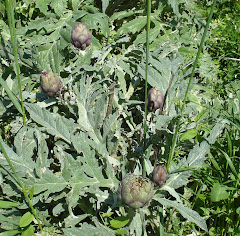
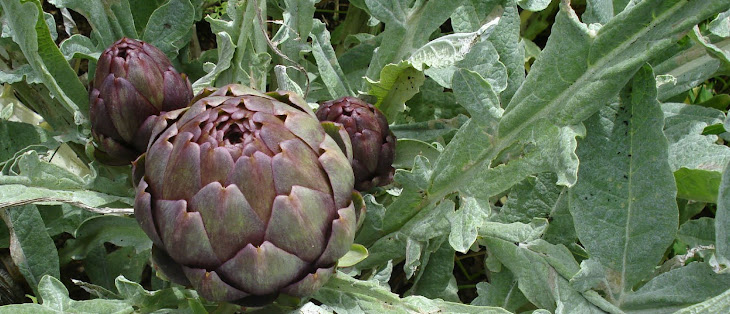
DSC03533 Our artichoke plants were all badly affected by the cold weather we had in March, which came just as the plants were beginning to grow again after the freezing temperatures we had in January.  This time last year we were picking artichokes, but this year I was afraid we weren’t going to get any at all.  So I was very pleased today to see that two small artichokes had appeared – after all, I didn’t want to have to rename the blog!

And olives ….

well, flower buds at least – our little Lucque tree is covered in buds.

DSC03541


We’ve been preparing the beds for the pepper plants and deciding how we’re going to fit them all in.  We have about 40 plants altogether, not counting chilli peppers, as this year we’ve managed to get almost all of them to grow well.  We’ll probably plant them out tomorrow and I’ll take some photos then.

Replacing the beans the birds had eaten

DSC03538 So many of our haricot and alubia bean plants had failed to appear or been eaten by birds that I germinated some in seed trays in the house.  Today we planted them out in the gaps, with some Planeta climbing mangetout beans as well.  I made a string of ‘bunting’ with strips of a plastic bag which I hope will deter the birds.

Roses and a butterfly on the wild thyme

DSC03535
There’s borage growing as a weed among the roses, but I think it looks good there.
DSC03544

Asparagus

The wild asparagus is almost over now but yesterday we bought some cultivated asparagus from a stall in a fair in the village.  It hadn’t come far, just 5 km from a nearby village, and it was delicious.  We had some of it with a vinaigrette dressing and crusty Aveyronnais bread, and also made an asparagus and goats’ cheese tart.

DSC03516 DSC03514

Sunday, 28 February 2010

Apricot buds and a new cold frame

One of the good things about writing a garden blog is that I can check back and see how this year compares with last year and the year before.  Spring seems to be late this year, but looking back to last February I can see that the apricot buds are at about the same stage this year, although the daffodils are certainly later.  Last year we had daffodils in flower in time for St David’s day – that won’t happen this year.

DSC01890 DSC01892 The apricot tree should be in flower in a few days’ time.

I sowed some mangetout peas about a month ago and had almost given up hope of the plants appearing.  I thought the seeds had been washed away by some of the heavy rain we’ve had and today I decided to sow some more in the same place.  Luckily I had a close look first because I noticed that they’re coming up at last.  We’ve covered them with chicken wire because the birds seem to like them.

DSC01893 mangetout peas emerging and, right, the garlic doing well. DSC01906 DSC01901 But the daffodils are late this year.

We’ve already got two rustic-looking cold frames in the garden, but our neighbour gave us an old window so Lo Jardinièr decided to make another one – they’ll all come in useful when our pepper and cucumber plants need a bit of protection before being planted out.  He made a base of sand covered with old terracotta floor tiles, made walls with concrete blocks and rested the window on top – very simple.

DSC01904 DSC01907

While he was doing that I sowed another double row of broad beans and a row of spinach.  We lost at least three sowings of spinach to heavy rain in the autumn, each time I re-sowed them there would be another storm and no sign of spinach plants, except for a solitary one which has survived the winter.  We miss having the young spinach leaves in our salads, so we hope to grow some now before the weather gets too hot and dry. 

Today’s harvest:

DSC01909 DSC01927

Rosemary, thyme and bay, which the garden provides all through the year, whatever the weather, chard, which is just recovering from the cold weather and starting to grow again, and cabbage.

Sunday, 24 January 2010

Sun, cloud and essential #2

Some days have been warm and bright, almost like spring, with the sun casting sharp shadows ….

DSC01250 DSC01248

and some days have been cold and grey …

DSC01253

… as it was yesterday when we went the Domaine d’Estève at Roquessels to buy wine – this was the view from there, looking back towards Gabian, which is behind one of the hills in the middle distance. 

In the garden we’ve cleared the ground where the pepper plants were last summer, ready to spread goat manure, and spread manure on another bed which we’ll use for tomatoes this year.  After working in the garden yesterday we were glad to come home to a hot meal of alubias beans given to us by our friend Drew in Navarra – they’re black when they’re dried, but turn reddish brown when cooked.  I soaked them overnight then cooked them for about an hour.  Then I added onion fried in olive oil, a finely chopped chorizo pepper, chopped garlic, some lardons (bacon pieces), some leftover cooked sausage and tomato purée made with our tomatoes.  We ate it with some slices of fried black pudding, chopped garlic and parsley and Aveyronnais bread from the village baker.

DSC01262 dried alubias – we’ll use some for seed. DSC01269

Olive trees

DSC01220 DSC01225 DSC01227

The road to Mas Rolland, where we went to fetch goat manure this week, passes a row of lovely old olive trees with beautiful twisted trunks like sculptures.

Essential batterie de cuisine #2 – espresso coffee maker

About thirty years ago my sister was living in Italy and brought us back one of these espresso coffee machines when they were still quite difficult to find outside Italy.  We still use it every day – it’s showing signs of use but it works perfectly.  It’s a very simple system – you fill the bottom half of the macchinetta (little machine) with water and fill the middle section with strong Italian fine-ground coffee, then heat until the water boils and is forced upwards through the coffee grounds and the coffee pours into the top section – magic!

DSC01274

This is our original thirty-year old coffee maker – much used and much travelled.  For years, when we went on holiday, we would take it with us and if we couldn’t find a café which sold good coffee (and this can happen even in France!) we would stop somewhere and make our own on a camping gaz stove.  So its battered, burnt, used-looking state is the result of years of gas flames, barbecues and campfires… but we still use it every morning to make our breakfast coffee.  One of the characteristics of this way of making coffee is that the coffee makers work best when they are full, so that this one (a six-espresso cup size) is fine for our two large breakfast cups of coffee, but we’ve found we need different sizes for different occasions:

DSC01276

So we have two 9-cup (one made of stainless steel), a 6-cup, a 3-cup and a 1-cup size.  I think this means we can make any number of perfect cups of coffee! 

Tuesday, 15 December 2009

First frost?

Tonight the temperature is forecast to fall below freezing for the first time this winter, with daytime temperatures at a chilly 5 to 6 degrees and a cold north wind. We think that the plants in the garden will all be able to withstand the cold, but just to make sure we put some straw around the broad bean plants today and covered the oregano to try to delay its inevitable winter dying back.

DSC00571 DSC00570

The broad beans are doing so well – we don’t want to lose them. The plants form the first sowing in October are in the photo on the left – they are about 30 cm tall now. In the photo on the right are the second (November) sowing of broad beans (left) and the Spanish habas. They all now have a blanket of straw around them at ground level.

And how long can the flowers last?

DSC00573 DSC00577
DSC00581 DSC00575

The roses and the osteospermum are all still blooming … so far.

Quinces again!

DSC00569


Yesterday a friend brought us this basketful of windfall quinces. They are very ripe, but rather damaged by insects. As we’ve already made plenty of membrillo this year, we’ve chosen the best to use in a stew with pork or lamb. The most damaged ones we’ve used to make a spicy quince pickle to eat with cheese or cold meats.


Spicy quince pickle

1 kilo chopped quince (with the peel, but not the cores); 500 gm brown sugar; 3 medium onions, chopped; 450 ml red wine vinegar; 100 gm raisins; juice and zest of a lemon; a 3cm-piece of ginger, peeled and grated; 2 teaspoonfuls cinnamon; 1 tablespoonful ground coriander; 1 heaped teaspoonful paprika (or more if you like); 1 teaspoonful salt.

Put all the ingredients in a large saucepan, bring to the boil and simmer for about 1 hour covered and 1 hour uncovered. Put into sterilised glass jars.

DSC00610

The pickle has a lovely colour and smells and tastes deliciously of quince. It scented the whole house while it was cooking!