Showing posts with label rose. Show all posts

Sunday, 17 April 2011

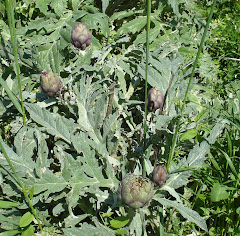
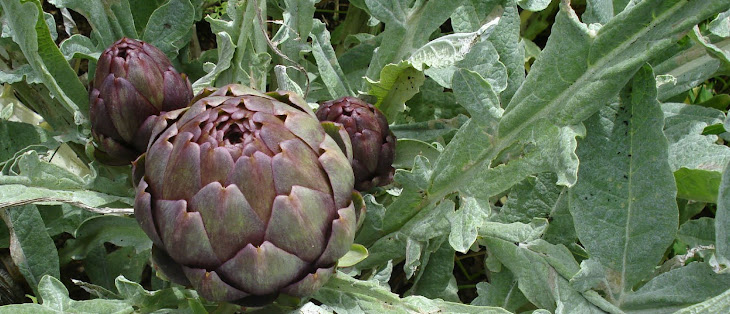
First sight of an artichoke

Several of the artichoke plants have small artichokes developing among their leaves, so it looks as though it may be a better crop than last year when the plants took too long to recover from the cold winter.

IMGP8843

We should be eating our own artichokes within a week or so!

Roses and olives

IMGP8848 IMGP8851
IMGP8876 IMGP8872
olive flower buds look so insignificant but the fruit will make a good harvest in the autumn, we hope.

…about to flower, while the broom and Banksiae Rose are almost over….

IMGP8888 IMGP8890

Tuesday, 15 February 2011

Sweet onions and more signs of spring

Our neighbour brought us a bunch of sweet onions from the Spanish border (not far away, a drive of an hour and a half perhaps and a frequent trip for many people here). These onions are a slightly earlier variety than the local one and so they’re useful to have before the oignons de Lézignan are ready to eat. They don’t need to be widely spaced and the ones that wouldn’t fit in this double row have been very closely spaced to be eaten as spring onions.

IMGP6509 IMGP6517 IMGP6512 IMGP6537

Crocuses and rose buds

IMGP6531 IMGP6523

The crocuses were opening in the sun this morning and the Rosa banksiae has not only leaf buds but flower buds as well.

Des arbres et des hommes’

On Friday night the Cercle Occitan organised an very interesting talk by the ethno-botanist Josiane Ubaud about the social and cultural reasons for the planting of different species of trees in the Languedoc region. She divides the trees into different groups. Social markers are those trees which were planted to show the social status of the owner of a property and foremost among these are the cedar, planted around prosperous winemaking domains from the eighteenth century onwards, and the palm, planted at seaside resorts to attract tourists and more recently in private gardens. Cultural, sacred markers are those which have been considered sacred since pre-Christian, Celtic times. Cypress trees are often planted at the entrances to cemeteries and because of this they have often been associated with death, but in fact are markers of passage, and so are planted at crossroads too. Their beautiful curving shapes, especially when they are blown by the wind, have been described by the Occitan poet Max Rouquette as flambadas sacradas, sacred flames. The bay tree (laurier noble), and specifically the female tree which bears berries, has been considered sacred since the time of the ancient Greeks and has give us the French word baccalauréat (berry of the laurier). The olive tree has also been seen as sacred throughout the ages of Mediterranean civilisation, because of its longevity and its ability to rejuvenate when apparently it has been killed. In the Languedoc, though, it has too much of an agricultural history to have been planted much in sacred places. Finally, the European hackberry tree (Celtis australis, micocoulier in French) has an Occitan name which demonstrates its sacredness: fanabreguièr which comes from the Latin word for temple (fanum) and the Celtic word for sacred wood (brogilum). We don’t see these trees often in this part of the Languedoc, as they are more likely to be planted to the east of us, near Montpellier. As well as traditionally being sacred, they are useful trees too, because they are deciduous and so give shade in summer but lose their leaves in winter to let the light through.

IMGP6187 IMGP6460 DSC04297

Above are some of my photos of some of the trees mentioned in Josiane Ubaud’s lecture: left, an olive tree (of course!), centre, a palm in the garden of a substantial house in Roujan, definitely a marker of social status, and right, a line of cypress trees planted on the boundary of a piece of land.

Un jardin sec n’est pas un jardin pauvre’

A dry garden is not a poor garden. This was repeated a couple of times by Josiane Ubaud who feels very strongly, as I do, that in this region we should not try to reproduce the lush green gardens of wetter climates, with their lawns and colourful summer flowers. This is something we have tried to follow when growing decorative plants in our garden – we try to plant only those varieties that can survive without watering once they are established.

We're hoping that Mme Ubaud will return next year to give the second part of her lecture - about the useful, decorative and food-providing trees. If you read French, her website is very interesting.

Tuesday, 16 November 2010

Pumpkin harvest, and The Birds?

Colder nights are forecast for later this week, so today we brought the remaining pumpkins back to the house so that they are not affected by any low temperatures we may have. The ones that have ripened should keep for months, the green ones maybe not for so long, so we’ll eat them first. Although a friend has suggested that they may continue to ripen indoors.

IMGP3361

Five pumpkins and two butternut squashes. We’ve already picked a butternut squash and two pumpkins, one which weighed 5 kilos and one, which we’re eating now, which weighed 10 kilos. The two bigger ones in this photo are even bigger. So far we used them to make soup, roasted chunks of them in the oven and puréed the roasted chunks to make a gratin with blue cheese – the simple recipe for this is on the Mediterranean cuisine blog. Today one of our friends passed by the garden and told us that you can make soufflé with pumpkin too, so we’re going to try that – if it works I’ll put the recipe on the blog.

The Birds

On the way back from Magalas we saw a remarkable sight – a huge flock of very small birds settled on the (not very busy) road. We watched them for about five minutes while I took a lot of photos. Each time a car came close they flew up into the sky and circled around the vineyards for just a few seconds before settling on the road again. There must have been hundreds, if not thousands, of them. There didn’t seem to be anything for them to feed on, so it’s a mystery why they were on the road. It seems a bit late in the year for birds to be gathering to migrate, but it’s possible they are migrating birds from further north either arriving here for the winter or just passing through. My researches on the internet and in bird books suggest they may have been Wood Larks. I’d welcome any other suggestions. They were much too small to be starlings.

IMGP3312
IMGP3314
IMGP3317

IMGP3322

IMGP3324
IMGP3328

And more autumn colour in the vineyards and in the garden

IMGP3342

IMGP3359
In the garden the rosemary and the roses have begun to flower again after the rain.
IMGP3347

An awful reminder…

Land being flattened next to our garden as work begins on the new houses.

IMGP3365 IMGP3368

The landscape seems to have been completely changed, trees destroyed and new vistas created.

Tuesday, 17 November 2009

Planting garlic

According to the calendar of the moon, last weekend was a good time to plant garlic, but we missed it, so we did it today, in a bed which we put a lot of goat manure in last winter.

DSC00108 DSC00159

Some of the garlic we bought in Villereal market when we were there in September – we bought 5 kilos, so we haven’t eaten it all yet!

DSC00156 DSC00160

We’ve put a drip-feed hose along the middle of the double row so that we can water the garlic easily in the late spring and early summer when it needs a lot of water. After planting the cloves about 7 or 8 cm apart we covered them with straw to conserve moisture and to try to stop the birds pulling them out before they root.

Our leeks are growing well and we pulled the first two today. We’ll eat them tonight sautéed in butter with pancetta.

DSC00155 DSC00164

DSC00166 Since we’ve had some rain and the ‘second spring’ has begun, the oregano has started to grow again, so I’ve cut some leaves to dry and store for the winter.


DSC00169

There are a few small aubergines still growing – we barbecued two for lunch today, with a sweet onion. The aubergines should carry on growing slowly until the first frost which could come any time now, but isn’t forecast for at least the next week.


There’s still a lot of colour in the garden – roses, especially, and the leaves of the cherry tree in the garden next to ours:

DSC00090 DSC00093
DSC00094 DSC00153

And we’re still harvesting green chillies although they won’t turn red at this time of year. I picked one today – there are more, but we don’t eat many hot peppers so I’ve left the rest for another time.

DSC00162

Sunday, 24 May 2009

Summer's here! / L'été est arrivé


Olive flowers / les fleurs d'olivier

At last, after a long cold spring, summer has arrived, with the temperature in the high 20s centigrade, and of course the need to water every day. / Enfin, après un printemps long et froid, l'été est arrivé, la temperature monte et on a besoin d'arroser chaque jour.

rose - pink 2_1_1 rose - pink_1_1
rose - red_1_1 lizard on gate_1_1

The roses are out and so are the lizards / Les roses sortent et aussi les lézards.

borlottis climbing_1_1 cucumber flower_1_1
The borlotti beans are climbing and the cucumber plants are flowering / Les haricots grimpent et les concombres fleurissent.
last artichokes 1_1_1 potato crop_1_1_1

We've picked the last artichokes (a sad moment for me) and the new potatoes are ready to eat. / Nous avons ramassé les derniers artichauts et les pommes de terre précoce sont prêtes à manger.

tomatoes_1_1_1 beans for seed_1_1
The tomato plants are doing well and the November sowing of broad beans are nearly over - we're saving these for seed as the variety, Seville, has given us a wonderful crop.
first courgette_1_1 first pepper_1_1

Our first courgette and first pepper have appeared. / La première courgette et le premier poivron ont apparu.