Our Lucque olive tree is covered in tiny flowers, a promise of a good crop in the autumn.
 |  |
 |  |
Our Lucque olive tree is covered in tiny flowers, a promise of a good crop in the autumn.
| | |
| | |
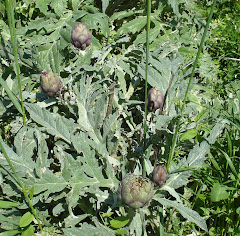
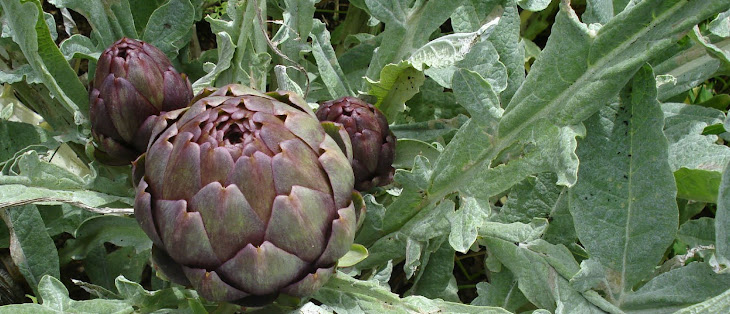
Several of the artichoke plants have small artichokes developing among their leaves, so it looks as though it may be a better crop than last year when the plants took too long to recover from the cold winter.

We should be eating our own artichokes within a week or so!
Roses and olives
 |  |
 |  olive flower buds look so insignificant but the fruit will make a good harvest in the autumn, we hope. |
…about to flower, while the broom and Banksiae Rose are almost over….
 |  |
Our neighbour brought us a bunch of sweet onions from the Spanish border (not far away, a drive of an hour and a half perhaps and a frequent trip for many people here). These onions are a slightly earlier variety than the local one and so they’re useful to have before the oignons de Lézignan are ready to eat. They don’t need to be widely spaced and the ones that wouldn’t fit in this double row have been very closely spaced to be eaten as spring onions.
 |  |  |  |
Crocuses and rose buds
 |  |
The crocuses were opening in the sun this morning and the Rosa banksiae has not only leaf buds but flower buds as well.
‘Des arbres et des hommes’
On Friday night the Cercle Occitan organised an very interesting talk by the ethno-botanist Josiane Ubaud about the social and cultural reasons for the planting of different species of trees in the Languedoc region. She divides the trees into different groups. Social markers are those trees which were planted to show the social status of the owner of a property and foremost among these are the cedar, planted around prosperous winemaking domains from the eighteenth century onwards, and the palm, planted at seaside resorts to attract tourists and more recently in private gardens. Cultural, sacred markers are those which have been considered sacred since pre-Christian, Celtic times. Cypress trees are often planted at the entrances to cemeteries and because of this they have often been associated with death, but in fact are markers of passage, and so are planted at crossroads too. Their beautiful curving shapes, especially when they are blown by the wind, have been described by the Occitan poet Max Rouquette as flambadas sacradas, sacred flames. The bay tree (laurier noble), and specifically the female tree which bears berries, has been considered sacred since the time of the ancient Greeks and has give us the French word baccalauréat (berry of the laurier). The olive tree has also been seen as sacred throughout the ages of Mediterranean civilisation, because of its longevity and its ability to rejuvenate when apparently it has been killed. In the Languedoc, though, it has too much of an agricultural history to have been planted much in sacred places. Finally, the European hackberry tree (Celtis australis, micocoulier in French) has an Occitan name which demonstrates its sacredness: fanabreguièr which comes from the Latin word for temple (fanum) and the Celtic word for sacred wood (brogilum). We don’t see these trees often in this part of the Languedoc, as they are more likely to be planted to the east of us, near Montpellier. As well as traditionally being sacred, they are useful trees too, because they are deciduous and so give shade in summer but lose their leaves in winter to let the light through.
 |  |  |
Above are some of my photos of some of the trees mentioned in Josiane Ubaud’s lecture: left, an olive tree (of course!), centre, a palm in the garden of a substantial house in Roujan, definitely a marker of social status, and right, a line of cypress trees planted on the boundary of a piece of land.
‘Un jardin sec n’est pas un jardin pauvre’
A dry garden is not a poor garden. This was repeated a couple of times by Josiane Ubaud who feels very strongly, as I do, that in this region we should not try to reproduce the lush green gardens of wetter climates, with their lawns and colourful summer flowers. This is something we have tried to follow when growing decorative plants in our garden – we try to plant only those varieties that can survive without watering once they are established.
We're hoping that Mme Ubaud will return next year to give the second part of her lecture - about the useful, decorative and food-providing trees. If you read French, her website is very interesting.
Today and tomorrow are said to be good days in the phases of the moon for sowing broad beans. Conditions in the garden were good for this too, after rain at the weekend and the horse manure we’d spread over the bean bed the previous weekend. We sowed the rest of a packet I bought last year of Sevilla broad (fava) beans, as well as some we had saved from last year’s crop. The plants sown in the autumn are doing well and don’t seem to have suffered from the cold as they did in last year’s severe frosts.

The rosemary has been in flower all through the winter, the garlic is growing well and there is bright green new growth on the olive trees following the pruning.
 |  |  |

The chard and spinach plants seem to be starting to grow again, the red cabbages are hearting up and a few small turnips were ready to eat for lunch today.
In most of the vineyards around the village there was a lot of slow, cold work going on. Each vine has to be pruned by hand, one at a time, between November and March, when the viticulteur/euse chooses which are the best shoots to bear this year’s crop. In the picture below, these old vines (probably about 50 years old) have not yet been pruned. In the background there’s an olive grove and a mimosa tree in flower. A typical view of early spring in the Languedoc.
This morning for the first time for weeks the sun felt hot and it was 16 degrees C in the garden. I know the winter’s not over yet – we’re not even half way through January – but there was a suggestion in the air that spring may arrive eventually.
The garden in January
Just for the record, this is what the garden looked like this morning.
 |  |
The rosemary has been flowering all winter and there were bees on it today. The broad beans look much better than they did this time last year and don’t seem to have been affected at all by the cold nights we had last month.
 |  |
Olive pruning
 |  |  |
I spent some time pruning the second of our two olive trees, the Lucque, not too drastically as it is still a very young tree that we planted only five years ago.
 |  Before (left), during (above) and after (right) |  |
The main aim when olive pruning is to open out the centre of the tree so I pruned any branches that were growing inwards, and I cut some of the straggly branches at the top. It’s growing into quite a nice little tree and it produced some good olives last year.
And a cauliflower

We picked this cauliflower – probably our last for this year, but there are still plenty of leaf vegetables: lettuces, red and green cabbages, spinach and chard, as well as some turnips, to feed us for the rest of the winter. The garlic and onions we planted in the autumn are all growing well too.
We’ve had our family staying for the past week – the reason why I haven’t posted on this blog for a while – and yesterday the weather was so warm and sunny that we spent several hours in the garden and had our lunch there for the first time for weeks.
 |  |  |
Before pruning the larger of our two olive trees quite severely I took photos of the branches in the sun.
 |  |
We burnt some of the old year, and the sun was so warm there was even a butterfly on one of the cold frames.
 |  |
A simple lunch in the sun – olives from the tree I’d just pruned, bread, olive oil, butternut squash soup and cheese.
Flamingos
 |  |
On a trip to Marseillan at the weekend we saw two groups of flamingos sheltering on the land side of the lagoon to keep out of the strong north wind. The lagoon, which is usually calm, was quite rough.
A midwinter feast
As we do every year, at midday on 25 December we had apéritifs in the garden – olives from our own trees and sweet wine made by friends in the village. We spent the rest of the afternoon, until it was dark, cooking and eating the various courses of the one meal we have on that day. Here are some of the dishes we ate:
 Apéritifs in the garden. |  Clams cooked in olive oil, garlic and parsley, with a glass of Cava we brought back from our trip to Catalunya in the autumn. |
 Foie gras with black and red peppercorns. |  Gambas – large prawns – sautéed in olive oil and garlic, with eau de vie added at the end of the cooking. |
 Pigeons with apricot stuffing. |  With the pigeons we drank a bottle of the best wine produced by our favourite vigneron at Roquessels. |
| There was grilled bream for our one non-meat eater, roast potatoes, and broad beans (from the garden and frozen last summer). All this was followed by Roquefort cheese, then a bûche de Noël made by the boulanger in the village. |  To finish, with our coffee, we had cherries from our neighbour’s tree which I preserved in Armagnac the summer before last. To finish, with our coffee, we had cherries from our neighbour’s tree which I preserved in Armagnac the summer before last. |