Showing posts with label artichoke. Show all posts

Wednesday, 4 May 2011

Artichokes and a lot of spring flowers

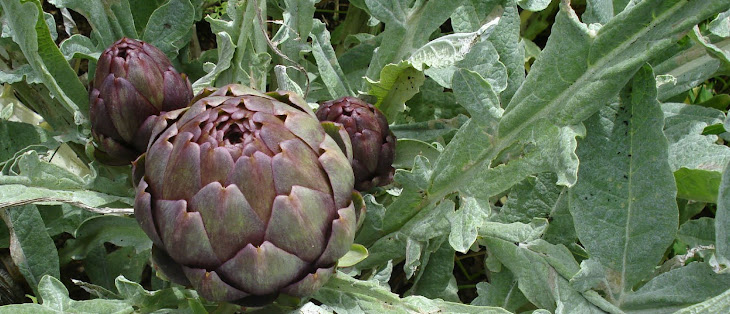
I picked three more artichokes this morning, making 9 in all this year, so the plants are doing much better than they did last year and there are plenty more still growing.

IMGP9416 IMGP9418

It’s the most colourful time of the year in the garden and in the garrigue because all the plants flower now before dying down again when the weather gets too hot and dry for them from June onwards.

IMGP9374 IMGP9404 Cistus (left), poppies (above) and irises (right). IMGP9388

And because the irises look so lovely now and won’t last for long I took a lot of photos of them this morning:

IMGP9386 IMGP9394
IMGP9387 IMGP9397

Sunday, 17 April 2011

First sight of an artichoke

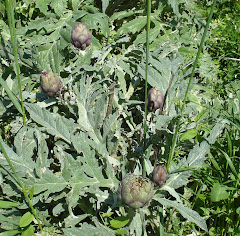
Several of the artichoke plants have small artichokes developing among their leaves, so it looks as though it may be a better crop than last year when the plants took too long to recover from the cold winter.

IMGP8843

We should be eating our own artichokes within a week or so!

Roses and olives

IMGP8848 IMGP8851
IMGP8876 IMGP8872
olive flower buds look so insignificant but the fruit will make a good harvest in the autumn, we hope.

…about to flower, while the broom and Banksiae Rose are almost over….

IMGP8888 IMGP8890

Thursday, 31 March 2011

Foire au gras and the last day of March in the garden

At the weekend we went on a trip to the Gers in south-west France, guided by friends who used to live in that area and know it well. The highlight of the visit was the Monday morning foire au gras in Samatan, devoted to the sale of foie gras and fattened ducks for making confit de canard and other south-western delights. I know that some people find the production of foie gras distasteful – if you are one of these then you should fast forward to the spring flowers at the end of this post. I’ve written about this subject before on my blog a couple of years ago. I believe that properly raised ducks and foie gras represent sustainable local food in an area which is well-suited to raising them. The life of a duck on the farm of a small producer in the Gers is so much better than that of an industrially kept chicken or duck that they cannot really be compared, so I make no apology for being a supporter of the traditional foie gras farmers.

The marché au gras at Samatan

Every Monday morning throughout the winter and until the end of March this market has two sessions – the first from 9.30 to 10.30 a.m. when producers sell duck carcases and a huge hall is filled with tables where people display anything from 20 to a hundred or so of their ducks for sale at very reasonable prices (around 2 euros per kilo this week). This session of the market then closes and another opens to sell foie gras. Again small local producers bring small numbers of foies gras for around 30 euros per kilo (this week). During spring and summer, from next week onwards the two markets are combined and the market is usually smaller although, apparently, the Easter Monday market is very popular and busy.

IMGP7812 IMGP7836

You choose your duck (above left) and then it is taken to be weighed at central scales before you pay for it. The foie gras is weighed by each stall holder. For 1 euro per bird you can take it to a cutting room where two men were working non-stop to joint the ducks. Some people had trolleys filled with twenty or so birds, for restaurants perhaps, others like us had just one.

IMGP7851 IMGP7852

These ducks are specially reared to have plenty of fat for preserving them and are not meant for roasting. Our duck was cut into: 2 legs and 2 wings for making confit de canard, 2 magrets or breasts which can be grilled, the neck to be used to make cou farci – the skin stuffed with pork meat to make a kind of sausage, the giblets for preserving in fat, and the carcass which was delicious grilled so that we could eat the tender slivers of meat that were left on it. I’ll write another post in the next day or so about how we have made confit, cou farci and preserved the foie gras.

In another market hall next door there was a live poultry and vegetable market, with farmers selling baskets of fresh eggs by the door.

IMGP7815 IMGP7822 IMGP7825

The chickens in cages looked a bit cramped, but were heading for a life in the open air as free range layers – nothing like the life of a battery hen!

IMGP7879 IMGP7883

Above left, the part of the market hall which is unused at this time of year, but would be used in winter when the market would be bigger, showing the size of this south-western phenomenon. On the right, one of the streets of the town where the usual market was taking place.

And the garden….

We came home with some oignons de Trébons, similar to our local Lézignan onions but with smaller bulbs. There’s some more about them in French here. Natives of the south-west, they may not do so well in our dry climate, but it’s worth a try.

IMGP8045 IMGP8027

Above left, some of the new onions next to the second sowing of broad beans; right, the artichoke plants are doing well and we’re hoping for artichokes next month.

IMGP8017
The tulips are out.
IMGP8039
One of the cherry trees given to us by our neighbour a couple of years ago is flowering for the first time.
IMGP8055 Borage IMGP8010


and bay.

Friday, 3 December 2010

From a frosty garden

We’ve had a couple of very cold nights, below freezing with frost in the garden.  Not nearly as cold as further north, and no snow here at all, but it’s still been quite wintry.  There were a few olives left on our Lucque tree, that weren’t quite ripe when we picked the others, but they seem to have gone rather mushy as though they’ve been affected by the frost, although I’d be surprised at this since some varieties aren’t harvested until January and there are almost always freezing temperatures before then.

IMGP3788
Red cabbages and cauliflowers
IMGP3792
The artichoke plants will soon recover
IMGP3790 Lettuce, which will also recover, we hope. IMGP3791-1 This little radicchio plant looks completely unaffected by the cold.
IMGP3798 The frosted aubretia  leaves looked pretty in the sun. IMGP3799 The broad beans have been protected by the layer of bamboo leaves.
IMGP3800
Frost melting on the palm leaves.
IMGP3802 Low sun sparkling through the fence.

And the building work goes on

IMGP3794 IMGP3805

Above right, two big machines and a lorry…. it’s very noisy in our garden now.  Above left, you can see how close the work is to the garden.

Sunday, 20 December 2009

After the freeze

DSC00631 DSC00670 DSC00675

We’ve had some very cold nights with temperatures down to minus 3 C on the balcony and, apparently, minus 6 C in the countryside around the village. Even during the days and in the sunshine there have been icicles on the fountains.


DSC00657 DSC00659 DSC00660

In the garden, the artichoke leaves (above, left) have been affected but they should recover, the habas and the second sowing of broad beans (centre) look completely unaffected while the first sowing of broad beans (right), plants which had grown to around 30 cm tall, have flopped a bit but should recover.

DSC00656


We’ve had bright, clear sunlit days with a cold north wind turning up the lovely silvery undersides of the olive leaves.


Milder weather is forecast for the coming week, so we’re hoping to be able to have our traditional apéritifs in the garden at midday on the 25th. Our only worry is that Eurostar get their trains going again so that our family can get here!

Monday, 28 September 2009

Still summer, or is it autumn? / Toujours l’été, ou l'automne?

We spent a few days staying with friends in a village in Navarra, in the Spanish Basque country, last week and everything seemed very green and damp there. / On a passé quelques jours avec des amis dans un village en Navarra, au pays Basque espagnol, la semaine dernière et tout y semblait très vert et humide.

DSC08913

The garden plots on the flat land between the river and the houses are used for vegetables, maize and cattle. Sheep are kept on the hillsides around the village and the air is filled with the lovely sound of their bells. / Les jardins sur la terre plate entre la rivière et les maisons sont utilisés pour les légumes, le maïs et les vaches. Il y a des brébis sur les collines autour du village et l’air et rempli du son de leurs clochettes.

DSC08959

Stacks of bracken, to be used for animal bedding, outside a house in the Basque village of Zubieta.

Des meules de fougère près d’une maison basque.


While we were away there was some rain here – heavy enough to wash away some of our seedlings but still not enough. It’s good to come back to bright light and dry days, but we need water for the garden. We’re still harvesting melons, courgettes, peppers and aubergines, and a few tomatoes.

Pendant que nous étions en vacances il a plu un peu ici – assez pour emporter des petits plants, mais pas encore assez pour le jardin. C’est bon revenir à la lumière éclatante et le temps sec, mais on a besoin de l’eau pour le jardin. On ramasse toujours les melons, les courgettes, les poivrons et les aubergines, et quelques tomates.

DSC09019 DSC09021 DSC09022

The artichoke leaves are beginning to grow again, our saffron crocus has flowered and the olives are beginning to ripen. / Les feuilles d’artichaut commencent à repousser, le crocus de safran fleuri et les olives commencent à mûrir.

DSC09037

We’ve brought back chorizo peppers from our friend in the Basque country and piments d’Espelette from the French Basque country to dry on the balcony. / Nous avons emporté des piments de chorizo de notre ami au pays Basque et des piments d’Espelette pour sècher sour le balcon.


DSC09053

And we’ve picked quinces to make membrillo like we did last year – the recipe is here.

Et nous avons ramasser des coings pour faire la pâte à coing - la recette est ici.

The basket is one I brought back from the Basque country, handmade from chestnut by an old man.