Showing posts with label borage. Show all posts

Thursday, 31 March 2011

Foire au gras and the last day of March in the garden

At the weekend we went on a trip to the Gers in south-west France, guided by friends who used to live in that area and know it well. The highlight of the visit was the Monday morning foire au gras in Samatan, devoted to the sale of foie gras and fattened ducks for making confit de canard and other south-western delights. I know that some people find the production of foie gras distasteful – if you are one of these then you should fast forward to the spring flowers at the end of this post. I’ve written about this subject before on my blog a couple of years ago. I believe that properly raised ducks and foie gras represent sustainable local food in an area which is well-suited to raising them. The life of a duck on the farm of a small producer in the Gers is so much better than that of an industrially kept chicken or duck that they cannot really be compared, so I make no apology for being a supporter of the traditional foie gras farmers.

The marché au gras at Samatan

Every Monday morning throughout the winter and until the end of March this market has two sessions – the first from 9.30 to 10.30 a.m. when producers sell duck carcases and a huge hall is filled with tables where people display anything from 20 to a hundred or so of their ducks for sale at very reasonable prices (around 2 euros per kilo this week). This session of the market then closes and another opens to sell foie gras. Again small local producers bring small numbers of foies gras for around 30 euros per kilo (this week). During spring and summer, from next week onwards the two markets are combined and the market is usually smaller although, apparently, the Easter Monday market is very popular and busy.

IMGP7812 IMGP7836

You choose your duck (above left) and then it is taken to be weighed at central scales before you pay for it. The foie gras is weighed by each stall holder. For 1 euro per bird you can take it to a cutting room where two men were working non-stop to joint the ducks. Some people had trolleys filled with twenty or so birds, for restaurants perhaps, others like us had just one.

IMGP7851 IMGP7852

These ducks are specially reared to have plenty of fat for preserving them and are not meant for roasting. Our duck was cut into: 2 legs and 2 wings for making confit de canard, 2 magrets or breasts which can be grilled, the neck to be used to make cou farci – the skin stuffed with pork meat to make a kind of sausage, the giblets for preserving in fat, and the carcass which was delicious grilled so that we could eat the tender slivers of meat that were left on it. I’ll write another post in the next day or so about how we have made confit, cou farci and preserved the foie gras.

In another market hall next door there was a live poultry and vegetable market, with farmers selling baskets of fresh eggs by the door.

IMGP7815 IMGP7822 IMGP7825

The chickens in cages looked a bit cramped, but were heading for a life in the open air as free range layers – nothing like the life of a battery hen!

IMGP7879 IMGP7883

Above left, the part of the market hall which is unused at this time of year, but would be used in winter when the market would be bigger, showing the size of this south-western phenomenon. On the right, one of the streets of the town where the usual market was taking place.

And the garden….

We came home with some oignons de Trébons, similar to our local Lézignan onions but with smaller bulbs. There’s some more about them in French here. Natives of the south-west, they may not do so well in our dry climate, but it’s worth a try.

IMGP8045 IMGP8027

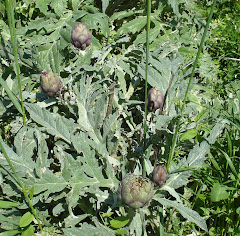
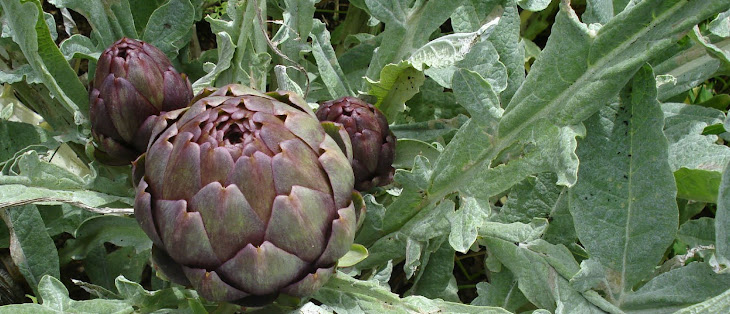
Above left, some of the new onions next to the second sowing of broad beans; right, the artichoke plants are doing well and we’re hoping for artichokes next month.

IMGP8017
The tulips are out.
IMGP8039
One of the cherry trees given to us by our neighbour a couple of years ago is flowering for the first time.
IMGP8055 Borage IMGP8010


and bay.

Saturday, 24 April 2010

Spring flowers, new vine leaves and another lizard

DSC03189
DSC03193

The vines are sprouting new spring growth in all the vineyards. We passed these near Roquessels this morning. And on the hillsides in the garrigue the asphodels, cistus, broom and thyme are all flowering.

DSC03216 DSC03218
DSC03224 DSC03220

DSC03228 DSC03232

In the garden, the apple blossom is nearly over, but we had borage flowers to decorate our salad of broad bean leaves, rocket and mint. I can’t see any small fruits on the apricot tree, although there are lots of leaves, so I think that the sudden cold weather we had in March must have killed off the fertilised flowers. We had a lot of blossom in February on the apricot tree, and insects buzzing around the flowers, so we expected a reasonable crop, until the surprise snow arrived at the beginning of March.

A lizard in the sky

This lizard run up the wall of the shed and onto one of the supports for our shelter to bask in the sun.

DSC03233 DSC03239

It’s been good weather for lizards. After an unusually cold spring, with that snow, it’s now unusually hot for April – up to 30 degrees C at midday in the sun – and very dry, although the stream is still running well down the hill past the gardens so we have plenty of free water.

Preparing to plant out the tomatoes

We have prepared most of the tomato beds and put up the cane supports for the plants. We’ve planted lettuce seedlings in between what will be double rows of tomatoes – the lettuces will get watered with the tomato plants, which will shade them a bit, and we’ll have eaten them by the time the tomato plants grow.

DSC03246 DSC03243

The tomato plants on the right have been in the mini-greenhouse on the balcony and are now desperate for more space and light, so we’ll be planting them out in the next day or so.

Friday, 10 April 2009

The hungry gap? / Le trou affamé?

april harvest_1_1

There isn't much to harvest in the garden at this time of the year, when the winter cabbages and leeks are finished and we're still waiting for the summer crops of tomatoes, courgettes, aubergines and peppers. But there is still a huge range of varieties of plants growing in and around the garden which we can eat.

Il n'y a pas beaucoup à ramasser au jardin à cette saison, mais il y restent plusiers de variétés de plantes qui poussent dans le jardin ou près du jardin que nous pouvons manger.

Yesterday we picked and ate 16 different varieties of leaf or flower:

Hier on a ramassé et mangé 16 variétés differentes de feuille ou fleur:

cos lettuce (laitue), spinach (épinards), sorrel (oseille), broad bean leaves (feuilles de fève), wild rocket (roquette sauvage), mint (menthe), parsley (persil), savory (sariette), oregano (oreganum), thyme (thym), chard (blettes), rainbow chard (feuilles de bette) - from the garden / du jardin.

borage flowers (fleurs de bourrache) - from the wild / sauvage.

coriander (coriandre), oak-leaf lettuce (feuille de chêne), mizuna - from the balcony / du balcon.

The chard and rainbow chard we ate cooked with mussels and an onion and white wine sauce. I used the herbs with goats' cheese to make parcels as I did with the borage leaves the other day. The other leaves made a salad to accompany them.

On a mangé les blettes et les feuilles de bettes avec des moules à la sauce au vin blanc. Avec les herbes j'ai fait des parcelles comme celles à la bourrache. Avec les autres feuilles j'ai fait une salade pour les accompagner.

We're looking forward to the summer vegetables, but in the meantime there are plenty of exciting flavours in the garden!

On attend avec impatience les légumes d'été, mais pour le moment il y a beaucoup de saveurs dans le jardin!

Tuesday, 7 April 2009

Borage and butterflies / La bourrache et les papillons

Borage has one of the prettiest flowers of all the herbs: purple stars which line the roadsides and the vineyards here in spring. The flowers can be put in salads and in drinks, the leaves can be cooked in soups and sauces. Today we picked leaves and flowers and I made borage and cheese parcels - the recipe is on the Mediterranean cuisine blog.
borage 1_1_1 borage parcels_1_1

La bourrache a des belles fleurs: des étoiles pourpres au bord de la route et des vignobles en printemps. On peut mettre les fleurs dans les salades et dans les boissons et les feuilles dans les soupes et les sauces. Aujourd'hui nous avons ramassé des feuilles et des fleurs et j'ai fait des pastelles à la bourrache et au fromage. La recette est sur le blog Mediterranean cuisine.

Borage is a good plant to have in the garden as it attracts bees and is said to improve the flavour of tomatoes grown nearby. Traditionally it has medicinal uses, including the relief of stress. But for me it adds colour to salads and flavour to dishes like these parcels. The older leaves have prickly hairs on them and so they need to be cooked. The young leaves are delicious in salads, with a taste like cucumber.

Two swallowtail butterflies were chasing each other around the garden and refused to stay still and pose for the camera. The best I could do was this action shot of one of them:

swallowtail_1

Deux machaons se pourchassaient autour du jardin et ils ont refusé de s'arreter pour le photo. J'ai dû prendre cette photo d'action.

and a butterfly coincidence ...

I had just posted my swallowtail photo when I looked at the Jardim com gatos blog and found I had been given this award - thanks gintoino!

I don't usually participate in these blog awards and games, but I can't resist this one! I read so many interesting blogs, but I'd like to forward it to the following blogs, the first two are about gardening in Mediterranean climates, like gintoino does in Portugal and like I do in the Languedoc, the third has beautiful photos and makes me laugh, the fourth is a good mix of campaigning and gardening ...
http://fromseedtotable.blogspot.com/
http://www.citygarden.eu/
http://inelegantgardener.blogspot.com/
http://homesteadinginacondo.blogspot.com/


The tulips were easier to photograph / les tulipes étaient plus faciles à photographier:

tulip1_1_1 tulip2_1