Showing posts with label garrigue. Show all posts

Saturday, 24 April 2010

Spring flowers, new vine leaves and another lizard

DSC03189
DSC03193

The vines are sprouting new spring growth in all the vineyards. We passed these near Roquessels this morning. And on the hillsides in the garrigue the asphodels, cistus, broom and thyme are all flowering.

DSC03216 DSC03218
DSC03224 DSC03220

DSC03228 DSC03232

In the garden, the apple blossom is nearly over, but we had borage flowers to decorate our salad of broad bean leaves, rocket and mint. I can’t see any small fruits on the apricot tree, although there are lots of leaves, so I think that the sudden cold weather we had in March must have killed off the fertilised flowers. We had a lot of blossom in February on the apricot tree, and insects buzzing around the flowers, so we expected a reasonable crop, until the surprise snow arrived at the beginning of March.

A lizard in the sky

This lizard run up the wall of the shed and onto one of the supports for our shelter to bask in the sun.

DSC03233 DSC03239

It’s been good weather for lizards. After an unusually cold spring, with that snow, it’s now unusually hot for April – up to 30 degrees C at midday in the sun – and very dry, although the stream is still running well down the hill past the gardens so we have plenty of free water.

Preparing to plant out the tomatoes

We have prepared most of the tomato beds and put up the cane supports for the plants. We’ve planted lettuce seedlings in between what will be double rows of tomatoes – the lettuces will get watered with the tomato plants, which will shade them a bit, and we’ll have eaten them by the time the tomato plants grow.

DSC03246 DSC03243

The tomato plants on the right have been in the mini-greenhouse on the balcony and are now desperate for more space and light, so we’ll be planting them out in the next day or so.

Friday, 17 April 2009

Some flowers in the garrigue / Quelques fleurs en garrigue

It was a lovely clear sunny morning and from Montesquieu we could see Mont Canigou and the Pyrenees, the peaks still covered with snow.  / Il a fait beau et clair ce matin et de Montesquieu on a pu voir le Mont Canigou et les Pyrénées, leurs sommets couverts de neige.

canigou from montesquieu_1

Olive trees live for centuries and often the original tree has died while new young trees have grown up around the beautiful shapes of the hollow centre.  / Les oliviers vivent pour plusiers siècles et souvent l'arbre original est mort et des arbres nouveaux ont poussé autour les formes belles du centre creux.

olive trunk 1_1_1 olive trunk 2_1_1
olive trunk 3_1_1 olive leaves_1_1

In the garrigue, the scrubby vegetation that grows on uncultivated hills, this is the time of year when the plants flower before dying back during the dry summer.  /  Dans le garrigue, la végétation broussailleuse qui pousse sur les collines, les plantes fleurissent à cette saison avant de perdre leurs feuilles et leurs tiges pendant la sécheresse d'été.

I find the website http://www.maltawildplants.com/ very helpful when I'm trying to identify Mediterranean plants.  It is an incredible work by one man, Stephen Mifsud, who is cataloguing and describing the flowering plants which grow in Malta.  Many of these are common to the area all around the Mediterranean, so it is an extremely useful data base.

Today we saw / aujourd'hui on a vu:

cistus albidus   wild asparagus_1_1 cistus close up_1 Cistus albidus
clustered sulla_1_1 Clustered sulla, Hedysarum glomeratum Lathyrus clymenum_1_1
Crimson pea, Lathyrus clymenum
thyme   wild asparagus_1_1

Thyme and wild asparagus growing together.

Le thym et les asperges sauvages ensemble.
asphodelus albus_1_1 asphodel
Asphodelus albus
aphyllanthes monspeliensis_1_1 aphyllanthes close up_1
Aphyllanthes monspeliensis

new salad box_1_1 Back at the garden, Lo Jardinièr finished making a new raised bed and planted out lettuce plants our nighbour had given us.  He made a wooden frame with some cast-off planks, put it on a patch of rough ground we haven't used before and filled it with a mixture of half compost and half soil.

Lo Jardinièr a construit une parterre pour les salades.

Thursday, 19 March 2009

Potting and pottering / Repiquer et bricoler

There seems to be so much to do in the garden at the moment ... watering, because the weather is suddenly hot and we've had very little rain for weeks, planting out lettuce seedlings, sowing other salad plants, preparing the ground for the pepper and tomato plants, having lunch ... and so on.

Il y a beaucoup de travail au jardin en ce moment ... l'arrosage, parce qu'il a commencé de faire chaud et il n'a pas plu pour quelques semaines, repiquer les salads, semer les autres salades, préparer la terre pour les poivrons et les tomates, manger le déjeuner ... etc.

I've repotted over 60 tomato plants (more than we'll need, but they're growing very slowly, so maybe they won't all survive) and some of the courgettes which already have quite large root systems.

J'ai repiqué plus de 60 plantes de tomates et quelques uns de courgettes qui ont déjà des longues racines.

courgettes_1_2_1

Over the past couple of weeks the garden has become a very noisy place as the bees buzz around the rosemary and the broad bean flowers. / Pendant les semaines dernières le jardin est devenu très bruyant avec les abeilles qui bourdonnent autour des fleurs du romarin et des fèves.

broad bean flowers   beetle_1_1

And on this broad bean flower there's one of the big flying black beetles which are very common in our garden.

2nd broad bean sowing_1_1_1

The second (February) sowing of broad beans are coming up well.  I'm specially pleased with these as they were seeds we saved a few years ago and had forgotten about!

Spring salad / salade du printemps

march salad_1_1

Rocket, wild rocket, oregano and sorrel leaves / les feuilles de la roquette, la roquette sauvage, oreganum et oseille.

Wild asparagus / les asperges sauvages

wild asparagus_1_1

A friend had given us some spears of wild asparagus she had picked and we added some spears from plants growing wild in our garden.  Wild asparagus is thinner than the cultivated variety, with a herby, more concentrated flavour.  It grows in the garrigue, especially where there has recently been a fire so that it has less competition from other bigger plants.  Here the tradition, especially on Easter Monday, is to go for a walk in the garrigue and pick asparagus and then make omelette with it.  We did this in the garden today.

Les asperges sauvages poussent dans la garrigue.  Elles sont plus fines que la varieté cultivée et elles ont un gout concentré.  Il y a une tradition ici d'aller dans les garrigue le lundi de Paque pour ramasser les asperges et puis de faire une omelette aux asperges.  On l'a fait au jardin aujourd'hui.

wild asparagus omelette 1_1_1_1 wild asparagus omelette 2_1_1 wild asparagus omelette 4_1_1

Pepper germination / germination de poivrons

We've had very high germination rates for most of the varieties we've sown.  All these seeds came from Kokopelli except the Long d'Espagne which our neighbour gave us.

Corno di Toro: 100 %    Italian Red Marconi: 100%  

Lipstick: 100%             Kolaska: 100 %

Kandil Dolma: 60 %      Nardello:  100 %

Long d'Espagne: 10 % (but these seeds were a few years'old)

Yellow cornos (from Kate) and chilli peppers (our own saved seed) were sown later and have not yet germinated.

The problem with the peppers now is to keep them at a consistently high enough temperature and give them enough light.  Today we put some of them out on the balcony under polythene, but some of them got a bit too hot and dry.  I think they'll be OK.

The apricot blossom is over now, and the cherry blossom is here ... / Les fleurs d'abricotier sont finis maintenant, et les fleurs de cerisier arrivent ...

cherry blossom_1
Cherry blossom opening on a tree near our garden - the tree is on public ground, so we'll keep an eye out for the fruit in May.
cherry blossom 2_1_1_1

Monday, 19 January 2009

Feeding the land / Nourrir la terre

Our garden needs a lot of organic material to improve the soil and to help it retain water during the dry summer. This morning we went a few kilometres into the hills to the Mas Rolland goat farm to collect manure. It's a beautiful drive, around hairpin bend after bend climbing between slopes covered with garrigue and holm oak trees (the Mediterranean evergreen oak) and rocky limestone outcrops.

road to montesquieu_1_1

Notre jardin a besoin de beaucoup de matière organique pour améliorer la terre et pour aider la retention de l'eau pendant la secheresse de l'été. Ce matin nous sommes allées quelques kilometres à la ferme de chèvres de Mas Rolland pour chercher de fumier. C'est une belle route - des virages en épingle à cheveux montent entre les collines couvertes de garrigue et de chênes verts et les affleurements de calcaire.

We took a trailer full of manure back to the garden and spread it on some of the beds we've cleared. / On a apporté une ramorque pleine de fumier au jardin et l'a mis sur la terre qu'on a nettoyé.

trailer of manure_1_1 muck spreading_1_1

muck spread_1_1

The garden after our morning's work / le jardin après notre travail

Good peasant food / un bon repas paysan

This was hungry work so we went home to eat a hearty peasant lunch of haricot beans cooked with salted belly pork which I'd prepared yesterday. / On est rentré chez nous pour manger un bon repas paysan - des haricots cuits avec de la poitrine salée que j'ai préparé hier.

haricot beans_1_1

The recipe will be on the Mediterranean food blog.

La recette sera sur le blog de la cuisine mediterranéenne.

Thursday, 8 January 2009

Snow and thoughts of spring / La neige et des pensées de printemps

Last night snow settled in Gabian - something we've never seen here before - just a light icing on the cars, roofs and plants in pots outside the windows. By the morning it had almost all gone.

Hier soir la neige est tombée à Gabian et elle est restée sur les voitures, les toits et les plantes dans les pots à l'éxtérieur des fenêtres. Ce matin elle est presque disparue.

Gabian snow 7-1-09_1_1 snow 7-01-09_1_1

Although it was still cold, after the snow melted and the sun came out our thoughts turned to spring seeds and planting. We want to try some new varieties this year so from Kokopelli we ordered some pepper (capsicum) seeds which we haven't grown before: Kandil Dolma - a Turkish bell pepper suitable for stuffing - and some long red varieties for salads and grilling and perhaps for drying: Italian Red Merconi, Lipstick, Corni di Toro and Kolesca. And from Seeds of Italy (Franchi) we've ordered Cavalo Nero (recommended by Michelle at From Seed to Table, Radicchio orchidea Rossa, Borlotto bean Lamon, some French beans - a dwarf Purple King and a climbing Smeraldo - and Raperonozolo Rampion. I'm especially excited about the last of these, the rampion, lo reponchon in Occitan, as it grows wild in the garrigue here and is mentioned by Max Rouquette in his poem, 'La Lenga s'es Perduda'.

Bien qu'il fasse froid encore, après la neige s'est fondue et le soleil est revenu nous avons pensé des semences de printemps et de la plantation. Nous voulons essayer des nouvelles varietés cette année, donc nous avons commandé de Kokopelli des semences de poivrons que nous n'avons pas cultiver: Kandil Dolma un poivron turque qui est bon pour farcir, et des autres varietés pour les salades, pour griller et peut-être pour secher. Nous avons commandé aussi des semences de Seeds of Italy (Franchi) y compris Cavalo Nero (recommandé par Michelle de From Seed to Table) et Raperonozolo Rampion. Je suis ravie de trouver cette dernière varietée - le raiponce, lo reponchon en Occitan - qui est une des plantes de la garrigue, le nom de laquelle j'ai trouvé dans une poème de Max Rouquette, 'La Lenga s'es Perduda'.

I can't wait now for the seeds and the spring to arrive! J'attends avec impatience l'arrivée des semences et du printemps!

box of seeds_1_1

And we have a lovely box full of vegetable seeds we've saved or friends have given us, some which Kate brought us and some Mizuna left from the packet Laura sent us. But any other suggestions are welcome. I learnt a new Occitan greeting this week - 'Bon anada, plan granada!', which means happy new year and may you have seeds for a good year. I think we have!

Wednesday, 4 June 2008

Generation to generation

In my Occitan class this week we read a piece by Gui Benoet about the knowledge of the natural world that older generations pass on to younger ones. Benoet comes from the Minervois area of the Languedoc, a beautiful, wild area of vines and rocky garrigue-covered hills with watercourses which rush water down from the mountains in winter but which are dry for most of the year. Some very good wine comes from this area. In the piece we read he was more concerned with the wild plants and animals which have provided food since people began living in these parts - in Occitan, las plantas, l'ensalada del Causse, las bèstias salvatjas, la pesca e la caça (plants, salad of the Causse, wild animals, fish and hunting). And the traditional ways of cooking which have been lost to modernity, like the ast or spit turning in the fireplace. Benoet is sad that his grandchildren will not see him turning a hare on one of these. Although we know that hunting is still an important part of life here. We've eaten delicious wild boar given to us by friends here.

While we were talking about all this, several members of the class spoke about learning from older people where they could find certain plants, especially the wild salad plants of the garrigue and mushrooms in the woods. Benoet mentions several varieties of mushroom which grow locally, including las aurelhetas, chanterelles. One class member said that his father-in-law had taken him to show him special secret places which he knew were good for mushrooms, passing on the information, keeping it in the family. It made me think about how important it is to have this transmission of knowledge from one generation to another. It happens in the gardens too, where we see a lot of middle-aged people who have taken over their parents' gardens and use the knowledge built up over centuries and passed on to them, usually by their fathers (this is still a traditional society where men garden and women cook). We benefit from this because our neighbours tell us what we should be doing - although sometimes the advice can be contradictory!

We don't see many young people in the gardens, though, and I wonder how much is being passed on these days. Just as the Occitan langauge almost disappeared within a generation during the middle of the twentieth century, a lot of traditional skills and knowledge are in danger of being lost. Thinking about this, I was heartened to see in L'Hérault, the magazine delivered to all the homes in the département, a photo of community gardens in La Paillade (a social housing estate in Montpellier). On ground surrounded by tower blocks there are plots of broad beans, leeks, herbs and a few flowers. Two local residents coordinate the activities in the parc de la Carriera. Local schoolchildren are brought to learn about gardening. And here, it seems, the older generation are passing on their knowledge to younger people. On the Montpellier Green Party website (here) there is an interview with one of the gardeners of La Paillade, a retired builder who says he is very pleased that he can advise young people and that they listen to his advice about gardening.

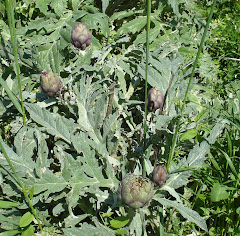
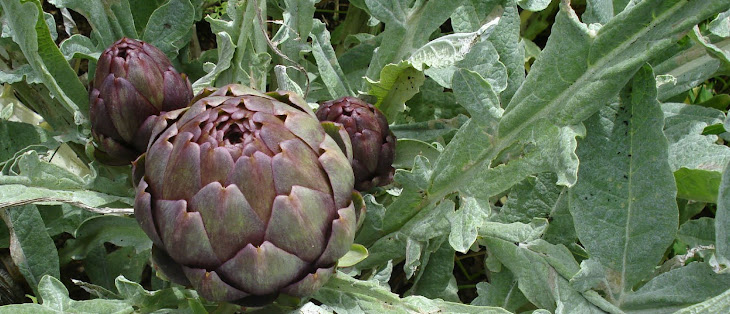
We had two bits advice today from our neighbour as he walked past. We should tie the leaves of the garlic, which are dying off now, into a knot to prevent bolting and to encourage the bulbs to swell. And we should put vinegar on our artichoke plants which have been infested with black fly.

garlic leaves tied in knots

Summer's here at last! The view from the chaiselongue:

Monday, 19 May 2008

Garrigue

broom-covered hillside, with an almost overwhelming scent

The garrigue which covers most uncultivated areas of land around the Mediterranean looks at its best in spring. This is the time of year when the plants flower, before dying back and 'hibernating' during the dry summer. There is another burst of flowering after the first rain in the autumn, but April and May is the time when rosemary, thyme, broom and cistus - the most dominant flowering plants - are at their most colourful.

The word 'garrigue' is a French word which comes from the Occitan 'garriga', land where only the oak - 'garric' - will grow. This is also said to link back to Celtic languages and the word for rock ('caer' in Welsh). Other parts of the Mediterranean have different names for the same vegetation - 'tomillares' (from the Spanish for thyme, 'tomillo', I suppose) in Spain, 'phrygana' in Greece, 'batha' in Palestine.

Areas of garrigue symbolise these rocky hillsides so much that you might think they were natural but in fact they are the result of human activity over thousands of years. From the time of the earliest settlements around the Mediterranean, people have cut down trees for firewood and cultivated the fruit trees and herbs which they found. Their sheep and goats have grazed the land for centuries, too. The loss of the forests has led to erosion of slopes leaving only the lower, hardier, less water-demanding plants which make up the garrigue.

The result is a mix of plants, most of which are evergreen: holm oak (evergreen oak), olivettes (small wild olive trees), broom, arbutus, rosemary, thyme and other herbs, and a colourful display of flowers in spring from asphodel, orchids and numerous small plants which grow wherever they find space.

asphodel


wild olive tree and cistus


Extensive fires have been in the news around the Mediterranean in recent years, in France, Greece, Portugal and elsewhere. These are frightening and dangerous, and often caused by people's carelessness (cigarette ends thrown from cars, picnic barbecues, and so on) and their colonising of previously wild areas, but some fire is also a natural part of the life-cycle of Mediterranean plants. Small areas of fire can be beneficial, clearing land for new growth. It is said here that the best places to find wild asparagus are where there have been fires in the past year or so.

Some other spring wild flowers:

wild gladiolus


thyme, cistus and Aphyllanthes monspeliensis


Galactites (I think)


honeysuckle


Flowers of the Mediterranean by Oleg Polunin and Anthony Huxley (Chatto and Windus, 1967) is the book I use for identifying Mediterranean plants - It's an excellent book with colour photos and good descriptions. I think there are newer editions and that it is still available.

There is a good article in French about the garrigue here as well as other interesting nature articles about the Languedoc on the same website.

And a short article in English here on the history of the garrigue.

And in autumn and winter ....

The arbutus bears its edible fruits at the same time as its flowers
(this picture was taken at the end of November)