Showing posts with label olive oil. Show all posts

Sunday, 8 May 2011

Spring fair

Today la rue de l’Eglise, the widest street in the old part of the village, and the place where the Wednesday market is usually held were lined with stalls selling goats’ cheese, sheep’s cheese, honey, wine, olive oil, flowering plants, vegetable garden plants, asparagus, strawberries, and handmade crafts.  The weather was dull in the morning but it cleared up later, and the day seemed to be a success.

IMGP9577 lemon trees, tomato plants, flowers…… IMGP9575
IMGP9578 goats’ cheeses from Mas Rolland…… IMGP9583
asparagus, churros and children’s rides…..
IMGP9573
our friends from le Moulin de Casso, which I wrote about when it first opened, selling their olive oil.
IMGP9580

We bought some Bouteillan and some Picholine olive oil, each with its own distinctive and delicious flavour.  The Picholine oil went very well first on its own with bread and then with some Mas Rolland goats’ cheeses at lunchtime, accompanied by a salad made with leaves from the garden and grated carrot and apple.

IMGP9588 IMGP9593

Monday, 2 May 2011

Planting out aubergines and finding a green lizard

We’ve planted out about a dozen aubergine plants our neighbour gave us – six of them next to a row of peppers on the left below.  We usually grow the grafted plants, bought from a garden centre, because they produce so many more aubergines than the ordinary plants, but this year we’ll try these, as well as a few grafted ones.  The Greek maize I planted out a couple of weeks ago is doing well (on the right below).

IMGP9309 IMGP9321
Sweet corn (maize) and a row of lettuce.

We also planted a row of chard, also given to us by our neighbour, next to the two rows of haricot beans which are growing quite well.  I picked the rest of last year’s chard today as it was going to seed, and we ate it this evening with pasta and cured ham.

IMGP9320

Our ‘big’ iris has started to flower (left below), later but more spectacularly than our white and mauve irises, and the red salvia was attracting a few bees (right).

IMGP9307 IMGP9304


And the green lizard under the olive tree

IMGP9280 IMGP9283

They’re much more shy than the brown wall lizards, so I was lucky to catch this one on camera!

IMGP9247 Our garlic is growing quite tall, but I don’t think it will ever be as good as the garlic I bought from this stall in Pézenas market on Saturday.  It’s very fresh and tastes wonderful chopped raw onto salads and other vegetable dishes.

And home to lunch….

IMGP9331 After working in the garden this morning we came home to a lunch of aubergine puréed with olive oil, garlic and oregano, some broad beans straight from the garden cooked with cured ham, and goats’ cheese from Roujan with thyme from the garden and olive oil that was milled in the village from olives from Servian, only about 10 kilometres away – all local, fresh and delicious!

Saturday, 17 April 2010

A Catalan break

I seem to have become a ‘weekend blogger’ – I don’t usually leave a gap of nearly a week between posts, but I have couple of excuses: first, I’ve been unable to connect to the internet for more than 15 minutes at a time since last Sunday night, something which has been resolved today by the installation of a new ‘Livebox’. And secondly, I’ve been away, staying for a couple of days in Banyuls-sur-Mer in the French part of Catalunya.

Banyuls is famous for its vin doux, a naturally sweet wine produced thanks to the amount of strong sunshine in that area. Squeezed between the Pyrenees and the rocky Côte Vermeille coast, the vines are grown in terraces anywhere on the slopes where there is space to make it worthwhile working the ground.

DSC02982
The vines were only just beginning to sprout this season’s bright green leaves, but these pictures show how close to the sea and the mountains the vineyards are.
DSC02998

The terraces are walled with local stone, with drainage channels leading down between them, and are sometimes wide enough for only two rows of vines.

DSC03008 DSC03018
DSC03023 DSC03015

The three variations of Banyuls – red, white and ambré (with added caramelised sugar to give a golden colour) – are all delicious apéritifs and can also be used in cooking. The chef at the restaurant at the Hotel des Elmes where we stayed was expert at this – two of the wonderful dishes we tasted were scallops and Catalan blood sausage with a reduction of Banyuls, and escalope of foie gras with a chocolate and Banyuls sauce. There’s more information about Banyuls on this website.

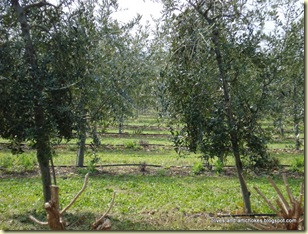
On the way home we stopped near Millas at the Moulin du Mas St Pierre where Monique and Joseph Planes decided some years ago to change their fruit farm into an olive farm. They now have 30,000 olive trees all of the Arbequine (Arbequina as it’s called in Spain) variety grown closely in rows, rather like the fruit trees in neighbouring farms. These Arbequine olives, grown mostly in Catalunya and Spain, are very small and Monsieur Planes told us that this gives them one great advantage over other varieties: the olive fly does not attack them because there isn’t enough flesh around the stone for it to burrow into the olive. This means that they have been able achieve organic status for all their production as they don’t need to use chemicals on the trees. There is a very modern mill at the farm and huge tanks where the oil is stored at a constant temperature of 18 degrees C to preserve the flavour of the oil. As always when we visit the premises of a producer of good food or wine, it was a delight to talk to someone as impassioned about his products as Monsieur Planes and, of course, to buy some of his wonderful oil to bring home. His passion and hard work have been rewarded, too, with a gold medal this year at the Concours Général Agricole in Paris. Madame Planes travels around the world – as far as Shanghai recently – to food fairs, so that now their oil is sold in many countries and even, M. Planes told us proudly, in Harrods in London.
DSC03027 DSC03028

Thursday, 31 December 2009

The Camargue and an olive mill

We treated ourselves to a couple of days in the Camargue, staying at Aigues-Mortes, a fortified town which was a port until it silted up and the sea moved out to Le Grau du Roi, about 6 kilometres away. We were hoping to see flamingos, and we did but the weather was so grey and misty that I couldn’t get good photographs of them.

DSC00866

The canal at Aigues-Mortes

DSC00880

A gloomy sky at le Grau du Roi

DSC00899 DSC00903

Bulls at a manade, where they are raised for the courses camargaises, the non-violent form of bull-fighting in which young men attempt to retrieve a rosette or ribbon from the head of a bull – more dangerous for the man than the bull!

DSC00906


An egret perched on the back of a horse.


Domaine d’Oulivie

On a detour on our way back from the Camargue, up a rough track near St Gely du Fesc (north-west of Montpellier) we found this olive mill, museum and shop surrounded by a huge grove of lovely mature olive trees.

DSC00908 DSC00914
DSC00919 DSC00921
DSC00924 DSC00910

We tasted the range of olive oils produced here and bought bottles of two: the single-variety Lucque oil and a special oil made by milling the olives with thyme and rosemary (rather than infusing the herbs after the oil is made). Wonderful flavours with which to end the year!

A l’an que ven! (Occitan for see you next year!)

Saturday, 12 December 2009

Olives and olive oil

This morning we went Christmas shopping, but in a very non-commercial way as we’re avoiding shopping centres this year, buying food and presents from local shops, markets and the internet for the sake of the environment and because we enjoy it more than the desperate rush around city shops.  So today we went to the olive oil cooperative at Clermont-l’Hérault.

DSC00500 DSC00499 DSC00505

The cooperative is easy to spot because of this lovely old olive press standing outside.  More modern equipment is used now, as in the new mill in Gabian

DSC00520 .Among other things, we bought some Lucques olives, and two varieties of olive oil including a Lucque ‘huile de Noël’, a lovely fresh-tasting oil which we’ll save for Christmas.


DSC00510 DSC00512

We drove back in bright sunshine past vineyards which are almost leafless now, this stone shelter built into the terrace beneath an olive grove (left, above) and a mazet (vine workers’ shelter) (right, above) with a fig tree and a chestnut tree growing next to it.

Curing our Lucque olives

DSC00532 DSC00537
DSC00539 I pricked each olive several times with a fork, mixed them in a bowl with some chopped dried oregano, bay leaves and salt.  Then covered them all with a good layer of salt.
I’ve left them in a cool place and they should be ready to eat in about ten days’ time.

This recipe comes from Max Lambert, L’Olivier et la Préparation des Olives.  I’m hoping the olives will be ready for our Christmas day aperitifs in the garden.

Mussels with cream and pastis sauce

As it’s one of the days when the coquillage producer comes to the village from Bouzigues, we had mussels for lunch, an experiment with crème fraiche and pastis – an experiment which worked very well!  Mussels and sauce were delicious.  We opened a bottle of Muscat sec, bought last week at Saint Preignan, which was the perfect accompaniment – not too dry and a lovely flavour.

DSC00526

The recipe is on the Mediterranean cuisine blog.

Thursday, 19 November 2009

Olive mill

From now until January, depending on the variety, is the time when the ripe black olives are harvested for oil. Sixty or seventy years ago there were three olive mills in our village, one of these in the same place as our house, and other villages would have had their own mills. But gradually these closed and in recent years the nearest mill has been the cooperative at Clermont-l’Hérault, about 25 kilometres away – quite a long way to transport small harvests of olives. Now, though, we have an olive mill in the village, Le Moulin de Casso, opened last week by three local olive growers to press their own olives and those of other growers in the area.

We visited the mill today and saw the brand-new machinery working, olives being delivered for pressing and people picking up their oil after pressing. It’s very exciting to see it all. We tasted two different oils, one unfiltered with a wonderful strong taste and another filtered one with a slightly more delicate taste. The mill isn’t yet registered to sell oil so we shall have to wait until next year to buy this local oil.

DSC00050-1

The approach to the mill, lined with olive trees, and with a view of the village in the background.
DSC00039
The olives are washed and any leaves removed (into the sack in the foreground).
DSC00044

The olives are taken to the machine which turns the flesh and stones into a pulp.
DSC00040
The pulp is mixed before going to the centrifuge which extracts the oil.
DSC00042
The oil comes out of the centrifuge and is filtered before being put in containers for collection or storage.

DSC00048 DSC00049
The waste pulp from which the oil has been removed is piped outside.

There was a wonderful smell of olives and olive oil in mill. It seems very popular as many local olive growers have already started bringing their olives here for pressing. It takes a tonne of olives to produce 110 to 120 litres of oil, depending on the variety, and this takes a day to process.

Last year in November I posted an ‘Olive Week’ series and I wrote about the olive mill we visited at St-André-de-Sangonis – here – le Moulin de Casso isn’t as big, yet, but it’s very exciting to have it here in the village.

My other Olive Week posts were about the origins and history of the olive tree and wood, oil and war, on the products and uses of the olive tree and, finally, they way in which the trees are destroyed in Palestine by the Israeli army as a way of suppressing the Palestinian people, something which still continues, tragically.