Showing posts with label haricot beans. Show all posts

Tuesday, 14 July 2009

Spanish breakfast in the garden / Un petit déjeuner espagnol au jardin

DSC07405

The tomatoes are ripening and the best time of day to work in the garden is the early morning before it gets too hot.  This morning in the garden we picked tomatoes straight from the plants to make the breakfast we’ve had in Catalunya and in Andalucia: peeled, chopped tomatoes with salt and olive oil on bread.  A wonderful start to the day!

Les tomates murissent et la meilleure heure du jour pour travailler au jardin est le matin avant qu’il fait trop chaud.  Ce matin nous avons ramassé des tomates pour faire le petit déjeuner que nous avons mangé en Catalogne et en Andalucia: des tomates pelées et hachées avec du sel et de l’huile d’olive sur des tranches de pain.

Today’s harvest / La récolte d’aujourd’hui

DSC07412-1 DSC07402
Haricot beans, courgettes, tomatoes, peppers, cucumbers and aubergines.  The Ananas tomato on the left above weighed 430 grams.

Plane trees update / Les platanes – mise à jour

There are rumours that it may be even worse than we feared and that the felling of plane trees in the village is part of a wider plan to cut down all the plane trees in the Hérault and Aude départements.  There will be a meeting next week to discuss the situation and what we can do about it.

On dit que peut-être c’est pire que nous avons craint et qu’il y a un project d’abattre tous les platanes dans l’Hérault et l’Aude.  Un réunion aura lieu la semaine prochaine pour discuter ce qu’on peut faire.

Saturday, 13 June 2009

The garden in June / Le jardin en juin

Today has been the hottest day of the year so far, over 30 degrees C at midday, so how is everything doing in the garden? / Aujourd’hui on a eu la journée la plus chaude de l'année jusqu'à ici. Donc, comment va le jardin?

The leek flower has finally come out / La fleur de poireau s’est finalement ouvert.

DSC05943 DSC06211
DSC06269 DSC06304
DSC06325 DSC06376

We hope it will provide us with a lot of seed / Nous éspèrons que cette fleur nous donnerons beaucoup de semences.

DSC06390

The olives are growing – these ones on our Lucque tree, the first year it has had olives on it.

Les olives poussent sur le Lucque. Ces sont son ses premiers olives.

DSC06371 DSC06375

We have beans on the haricots (Beurre and Purple King) and the Borlottis (left above). / Nous avons des haricots verts (Beurre et Purple King) et Borlotti (gauche).

DSC06384 DSC06382

The peppers and tomatoes are growing / Les poivrons et les tomates poussent ….

DSC06397-1

and the grapes /

et les raisins.

DSC06329 DSC06331

The garlic heads are small but better than last year / Les têtes d'ail sont petites, mais mieux que l'année dernière.

We’re eating courgettes every day and I stuffed some of the flowers with mint to cook on the barbecue. / On mange les courgettes tous les jours et j’ai fait des fleurs de courgette farcies à la menthe.

The stream from the spring is still running well, so we have plenty of water – we hope it continues. / Le ruisseau de la source coule bien toujours, donc on a beaucoup d’eau – on éspère que ça continuera.

Any failures? Well, yes. The pepper plants we grew from seed haven’t grown well at all and we’ve had to buy plants. Everyone here says the same. A lot of our bean plants, especially the climbing ones have been eaten by birds as they germinated. We’re protecting the new sowings with straw now and that seems to be working.

Monday, 19 January 2009

Feeding the land / Nourrir la terre

Our garden needs a lot of organic material to improve the soil and to help it retain water during the dry summer. This morning we went a few kilometres into the hills to the Mas Rolland goat farm to collect manure. It's a beautiful drive, around hairpin bend after bend climbing between slopes covered with garrigue and holm oak trees (the Mediterranean evergreen oak) and rocky limestone outcrops.

road to montesquieu_1_1

Notre jardin a besoin de beaucoup de matière organique pour améliorer la terre et pour aider la retention de l'eau pendant la secheresse de l'été. Ce matin nous sommes allées quelques kilometres à la ferme de chèvres de Mas Rolland pour chercher de fumier. C'est une belle route - des virages en épingle à cheveux montent entre les collines couvertes de garrigue et de chênes verts et les affleurements de calcaire.

We took a trailer full of manure back to the garden and spread it on some of the beds we've cleared. / On a apporté une ramorque pleine de fumier au jardin et l'a mis sur la terre qu'on a nettoyé.

trailer of manure_1_1 muck spreading_1_1

muck spread_1_1

The garden after our morning's work / le jardin après notre travail

Good peasant food / un bon repas paysan

This was hungry work so we went home to eat a hearty peasant lunch of haricot beans cooked with salted belly pork which I'd prepared yesterday. / On est rentré chez nous pour manger un bon repas paysan - des haricots cuits avec de la poitrine salée que j'ai préparé hier.

haricot beans_1_1

The recipe will be on the Mediterranean food blog.

La recette sera sur le blog de la cuisine mediterranéenne.

Thursday, 8 January 2009

Snow and thoughts of spring / La neige et des pensées de printemps

Last night snow settled in Gabian - something we've never seen here before - just a light icing on the cars, roofs and plants in pots outside the windows. By the morning it had almost all gone.

Hier soir la neige est tombée à Gabian et elle est restée sur les voitures, les toits et les plantes dans les pots à l'éxtérieur des fenêtres. Ce matin elle est presque disparue.

Gabian snow 7-1-09_1_1 snow 7-01-09_1_1

Although it was still cold, after the snow melted and the sun came out our thoughts turned to spring seeds and planting. We want to try some new varieties this year so from Kokopelli we ordered some pepper (capsicum) seeds which we haven't grown before: Kandil Dolma - a Turkish bell pepper suitable for stuffing - and some long red varieties for salads and grilling and perhaps for drying: Italian Red Merconi, Lipstick, Corni di Toro and Kolesca. And from Seeds of Italy (Franchi) we've ordered Cavalo Nero (recommended by Michelle at From Seed to Table, Radicchio orchidea Rossa, Borlotto bean Lamon, some French beans - a dwarf Purple King and a climbing Smeraldo - and Raperonozolo Rampion. I'm especially excited about the last of these, the rampion, lo reponchon in Occitan, as it grows wild in the garrigue here and is mentioned by Max Rouquette in his poem, 'La Lenga s'es Perduda'.

Bien qu'il fasse froid encore, après la neige s'est fondue et le soleil est revenu nous avons pensé des semences de printemps et de la plantation. Nous voulons essayer des nouvelles varietés cette année, donc nous avons commandé de Kokopelli des semences de poivrons que nous n'avons pas cultiver: Kandil Dolma un poivron turque qui est bon pour farcir, et des autres varietés pour les salades, pour griller et peut-être pour secher. Nous avons commandé aussi des semences de Seeds of Italy (Franchi) y compris Cavalo Nero (recommandé par Michelle de From Seed to Table) et Raperonozolo Rampion. Je suis ravie de trouver cette dernière varietée - le raiponce, lo reponchon en Occitan - qui est une des plantes de la garrigue, le nom de laquelle j'ai trouvé dans une poème de Max Rouquette, 'La Lenga s'es Perduda'.

I can't wait now for the seeds and the spring to arrive! J'attends avec impatience l'arrivée des semences et du printemps!

box of seeds_1_1

And we have a lovely box full of vegetable seeds we've saved or friends have given us, some which Kate brought us and some Mizuna left from the packet Laura sent us. But any other suggestions are welcome. I learnt a new Occitan greeting this week - 'Bon anada, plan granada!', which means happy new year and may you have seeds for a good year. I think we have!

Monday, 7 July 2008

Terracotta pot watering system

About a week ago we installed the terracotta pot watering system, as suggested by Kate at Hills and Plains seedsavers, but a less sophisticated system than hers. We've started with four pots and plugged the holes in the bases with corks. We dug holes for them and filled in the space around them with a mix of soil and compost. We've used old floor tiles as lids and unlike Kate have not connected them to a hose for filling up. We may do this next year, but this time we're just going to fill them up with a watering can or a hose by hand.

Once the row of pots were in, I sowed haricot verts (French beans) around the pots. I watered the soil where the seeds were, around the pots, until they germinated. Now that they have germinated we're watering straight into the pots and it seems to be working well. The soil around the pots seems to be damp all the time. And, an added bonus, the snails have left the seedlings alone. I think this is because the surface of the soil isn't damp. In the past we've lost whole rows of haricots to the snails and had to use snail pellets to protect them.

And an update on the prickly pear cuttings:

The four cuttings have grown quite an extensive root system in only three weeks. This surprised me as the information I could find suggested that they would take some months to root.

Two of the plants have now been transplanted to the garden. I'm hoping to grow the other two in pots outside the house.

Saturday, 19 April 2008

First artichoke

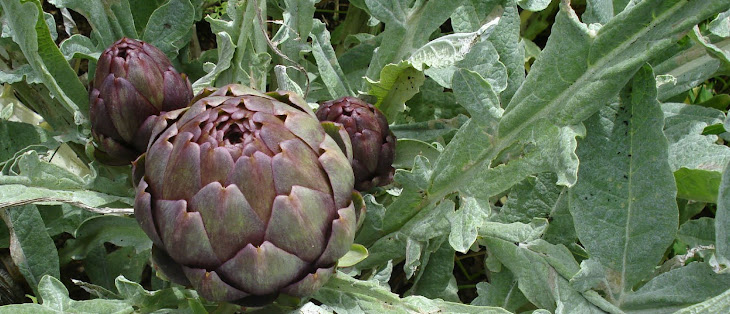
Today I cut the first artichoke of the year, the bigger one in this picture. This should encourage the smaller ones around it to grow. One small artichoke isn't much between two people! So I made a dish we once ate as a first course in a Greek restaurant in London:

Artichoke with broad beans

artichokes - preferably at least one per person

broad beans

1 sweet onion, sliced thinly

1 garlic clove, sliced thinly

3 tablespoons of tomato passata

oregano

lemon juice

olive oil

white wine

salt and pepper

Cut the outer leaves off the artichokes and remove any choke - if the artichokes are small like this one there won't be any choke. You can either leave the artichoke hearts whole or quarter them. Simmer these with the peeled stalks in a mix of olive oil and a little white wine until they are tender. Meanwhile simmer the broad beans in water (for just a couple of minutes if they are young fresh ones like I picked today) and sauté the onion and garlic in a little olive oil. Mix all the ingredients together, including the oregano, tomato, salt and pepper, and serve warm or cold.
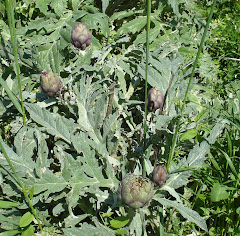
After the rain the garden is very green and it's hard to imagine that in a couple of month's time it will all be dry, except where we water, and will stay like that till September. I sowed haricot beans, the first sowing of the season. I've bought some snail pellets which claim not to harm animals and to be usable in an organic garden. Last year the snails ate my haricot bean plants as soon as they had two leaves, so I'll be watching them carefully this year and I'll use the pellets if necessary. I don't mind if the snails take the odd bite of a leaf, I'm willing to share, but I don't want them taking the whole plant! I'd welcome any suggestions about how to deter them.