Friday, 13 November 2009

Red vine leaves

Although the sun wasn’t shining today and the sky was grey, the leaves in this vineyard near Chateau de Cassan on our way to Roujan were a wonderful deep, purplish-red colour which looked beautiful against the olive trees. I think these vines are Grenache (Garnacha in Spanish, Garnatxa in Catalan).

DSC00057

DSC00052

DSC00053 In the photos above, between the rows of vines, you can see the white flowers of the false rocket which is sown in the vineyards and then ploughed in as a green manure. It self-seeds everywhere, including in our garden, and you can eat it. It tastes just like rocket but with a slightly coarser leaf.

Thursday, 12 November 2009

Salt-curing the olives

When I researched olive-curing in books and on the Internet, there seem to be so many ways of doing it and every recipe is slightly different from the next one. In the end, the method I’m using is a simplified version of several of the ones I came across. It’s the first time I’ve salt-cured olives – last year we cured them in brine rather than dry salt – so this is an experiment. I’ll keep you updated with progress over the next couple of months as we see how it works.

DSC00034

First, I rinsed the olives and left them to drain for 24 hours. Some of them were still a bit damp so I dried them with kitchen paper. Then I layered them with coarse salt in an earthenware casserole dish, a thick layer of salt, followed by a layer of olives, another layer of salt, olives, and a final thick layer of salt.

DSC00025 DSC00028
DSC00029 DSC00031

I then covered the casserole with its lid and put it on the stairs, which is the place in the house with the most constant, and the coolest, temperature. I shall check it in a couple of days’ time to see if there is any liquid to drain off. According to the recipes I have seen, the curing should take one to two months. It is possible to cure the olives more quickly by pricking them with a fork before salting – this method takes only a week. Maybe I’ll try that another time.

Tuesday, 10 November 2009

Olive harvest

This morning I picked the olives from the older of our two trees, which we planted about five years ago. There were 178 undamaged ripe olives – more than double the 80 we picked last year. If the number carries on increasing at this rate I won’t be counting them individually next year!

DSC09999 DSC00008

I’m thinking of trying something new with them this year – dry salt curing. I’ve found a few recipes for this and the one on www.greek-recipe.com looks the simplest. The olives have to be rinsed and then layered with salt in a clay pot (other recipes suggest a basket or slatted box) for 1-2 months. Once cured they will not keep as long as brine-cured olives, but that shouldn’t be a problem as we’ll eat them quite quickly!

The olives on our smaller tree, the Lucques, are not quite ripe yet, so I’ll pick them in a week or so. I think I’d prefer to use the recipe I’ve used before for them, as I know it works, but more on this when they’re ready to be cured.

Some last tomatoes and more gifts …
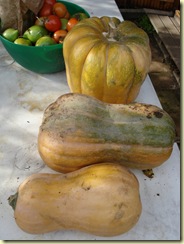
DSC00012 While I was picking the olives and sowing some mangetout peas and more broad beans, Lo Jardinièr cleared the St Pierre and the Coeur de boeuf tomato plants. There were still some edible green and red tomatoes on the plants. Our neighbour gave us three pumpkins of different varieties, too. I hope they keep well as it will take us some time to eat them all. It's impossible to say no to people's generosity here.

Monday, 9 November 2009

Lo Jardinièr’s green tomato jam

DSC09979

The tomatoes we picked the other day are ripening quite quickly, but there were still a lot of green ones for Lo Jardinièr to use to make green tomato jam.

DSC09991

Green tomato jam

2 kilos green tomatoes, 1 kilo brown sugar, juice and zest of 1 lemon, a pinch of salt.

Finely chop the tomatoes and mix with the sugar, salt and lemon.  Leave for 3 hours.  Bring to the boil and cook for about an hour, until it reaches setting point.  Bottle in sterilised jars.  This makes about 4 x 400 gm jars.

It’s very good with cheese, especially goats’ cheese.  We ate some for lunch today with toasted goats’ cheese and a salad made from chicory, blue cheese and bacon.

DSC09981 DSC09983

Thursday, 5 November 2009

Clearing away the summer

This morning the sky over the garden was cold and grey with the sun trying to break through the clouds.  The sun did come out later, but it was time to clear away the Roma tomato plants anyway.

DSC09917 DSC09926

Some of the tomatoes will ripen, the others we’ll use to make green tomato jam which we’ve found goes very well with cheese, especially goats’ cheese.


DSC09915 DSC09918

The broad beans and peas are coming up well.  We put the straw over the rows to conserve water, but I don’t think it’s really necessary any more.  Although we haven’t had a lot of rain lately the soil is very damp.


DSC09929 DSC09931

A friend went to the Spanish border at Le Perthus and brought us back this bunch of over 100 Spanish sweet onions to plant.  They should be the first onions to be ready to eat in the spring, before the local Lezignan sweet onions.  The excitement of planting these and seeing the peas and broad beans coming up compensates a bit for the sadness I always feel in autumn as the days get shorter and the weather gets colder.

We’re lucky here, though, to have a second spring in autumn, when it rains and plants start to grow again and to flower after dying back during the dry summer.


DSC09920 The rosemary is covered with flower, although the pyracantha looks quite christmassy! DSC09922


DSC09937 DSC09933 Our little palm is a Washingtonia, which is hardy here so it doesn’t need to be wrapped up for winter.  There are new leaves growing from the centre (above).

Wednesday, 4 November 2009

(Almost) full moon and a pumpkin

DSC09910 DSC09908

First thing this morning, as the rain clouds cleared away (for a while), the moon was still shining.

DSC09878 DSC09890

A friend and garden neighbour gave us this pumpkin a few days ago.  We’ve cooked it in different ways as part of several meals.  The easiest, and a very tasty way, is to cut it into chunks and roast it in olive oil with garlic, rosemary and thyme in a hot oven until the chunks are browned on the edges.  We ate it like this with the pot roasted guinea fowl I made the other day – recipe here.  Another way – Lo Jardinièr made this, is to parboil the chunks and then sauté them in olive oil in a cast iron pan over a high heat and then add ground cumin seeds at the last moment.

Other ways with pumpkin …

Pumpkin gratin, the recipe for which I put on the Mediterranean cuisine blog last year, is delicious too.  Or you can purée the pumpkin, put pieces of blue cheese on top and brown it under the grill.  I use Bleu d’Auvergne or Bleu des Causses for this, but Stilton would work just as well.  This makes a light meal or a first course with some crusty bread.

Pumpkin soup would make a good warming autumn dish too.  Maybe I’ll make it with the piece we’ve got left.

Sunday, 1 November 2009

Chard, vines and clouds

As the aubergines, peppers and tomatoes come to an end it’s time to start eating the chard we’re growing for the winter. We’ve got two rows of chard plants, some given to us by a neighbour as seedlings and one row of plants that we found had self-seeded all around the garden. Today we ate some chopped leaves simply cooked in boiling salted water, drained and then tossed in olive oil and chopped garlic.

DSC09874

DSC09861
Vineyards near Faugères yesterday – the different varieties of vine turn gradually different colours, marking out the vineyards.
DSC09865 At sunset yesterday, the clouds were beginning to gather. Rain is forecast for the next couple of days – good for the garden and the spring at the top of the hill.

DSC09847
I’ve brought the peppers indoors to finish drying as the nights are cooler now.
DSC09868
And a Sunday treat – I made middle eastern sweetmeats with walnuts, dates and ground almonds.