Wednesday, 30 April 2008

More artichokes ... and tapas

We've had two trips over the border this month - to Andalucia, and to Navarra and the Basque country - and we've come back with lots of food ideas ... and some food: cheeses from the Basque country, cured sausages, olive oils from Andalucia, red wine from Navarra and so on. I'll be writing more about all of these soon, but meanwhile we've come back to some good things too so here are some tastes from this week in Gabian.

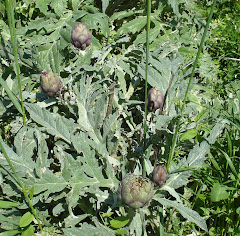
The garden is very overgrown with weeds, so we'll be doing a lot of work there over the next few days, weeding and planting out tomato, pepper, aubergine and courgette plants. The artichokes are growing and I picked a couple more small ones when we got back. I used them to make a very simple dish which I ate in Figueres, Catalunya, a year or so ago: use small artichokes which do not need to have the choke removed. Cut off the outer leaves and peel the stalk, slice them downwards in thin cross-sections, about 2 mm, sprinkle them with lemon juice as you cut the slices so that they do not go brown, then sauté them in olive oil for a few minutes until the heart and stalk soften and the ends of the leaves start to crisp a bit. Arrange on a plate and sprinkle with salt and pepper. It's a simple but delicious tapas or first course.

We had a sage bush which had grown rather woody so this spring we pruned it back quite drastically and now there is lots of new growth. We picked some of these leaves for Lo Jardinièr to make another simple tapas dish: Wash and dry some large sage leaves. Prepare a batter using chickpea flour, salt and water, mixed to the consistency of single cream. Dip the sage leaves in the batter then fry in olive oil for a few minutes.

This morning in the market in Gabian I was thrilled to see some of this season's fresh garlic. It looks so beautiful it almost seems a shame to eat it.

In the garden this afternoon a lizard was enjoying the heat of the sun on a terracotta sculpture.

Tuesday, 22 April 2008

Irises


These irises were hard to photograph in the wind today. These are in our garden, but growing wild when we found them in the undergrowth and they're coming out all along the roadsides and by the side of the vineyards now too. The purple ones seem to come first, following by the white-flowered ones. They must have been planted at the edges of the vineyards, but they seem to naturalise and spread and enjoy the dry climate.

Saturday, 19 April 2008

First artichoke

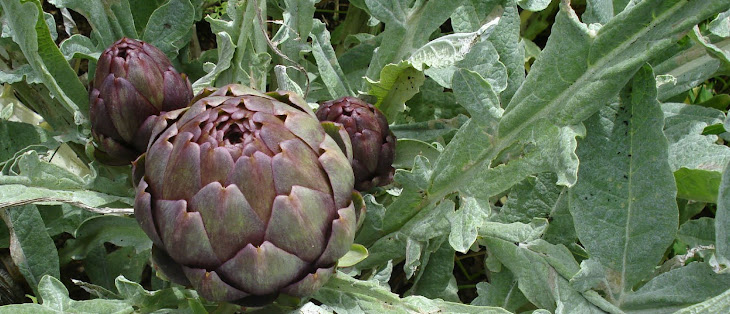
Today I cut the first artichoke of the year, the bigger one in this picture. This should encourage the smaller ones around it to grow. One small artichoke isn't much between two people! So I made a dish we once ate as a first course in a Greek restaurant in London:

Artichoke with broad beans

artichokes - preferably at least one per person

broad beans

1 sweet onion, sliced thinly

1 garlic clove, sliced thinly

3 tablespoons of tomato passata

oregano

lemon juice

olive oil

white wine

salt and pepper

Cut the outer leaves off the artichokes and remove any choke - if the artichokes are small like this one there won't be any choke. You can either leave the artichoke hearts whole or quarter them. Simmer these with the peeled stalks in a mix of olive oil and a little white wine until they are tender. Meanwhile simmer the broad beans in water (for just a couple of minutes if they are young fresh ones like I picked today) and sauté the onion and garlic in a little olive oil. Mix all the ingredients together, including the oregano, tomato, salt and pepper, and serve warm or cold.

After the rain the garden is very green and it's hard to imagine that in a couple of month's time it will all be dry, except where we water, and will stay like that till September. I sowed haricot beans, the first sowing of the season. I've bought some snail pellets which claim not to harm animals and to be usable in an organic garden. Last year the snails ate my haricot bean plants as soon as they had two leaves, so I'll be watching them carefully this year and I'll use the pellets if necessary. I don't mind if the snails take the odd bite of a leaf, I'm willing to share, but I don't want them taking the whole plant! I'd welcome any suggestions about how to deter them.

Thursday, 17 April 2008

Spanish souvenirs

There was a bit of rain while we were away, and our neighbour had done some watering for us, so the garden looked quite luxuriant when we got back - unfortunately a lot of the new growth was weeds! But we found peas and broad beans ready to pick, the last of the winter cabbages and the chard which just seems to go on and on.

We ate wonderful food in Spain and brought back lots of recipe ideas to make at home. Here are a couple of dishes we've made already with vegetables from our garden, the simplest first.


Peas in their pods

In a tapas bar in Murcia we found a bowl of peas in their pods for customers to help themselves to. At home we picked our first peas and ate them straight from the pods - a memory from my childhood when we used to do this in my grandmother's garden. Much better than cooking them.

Cured ham with broad beans

I simmered our first small broad beans for just a couple of minutes and lightly sautéed in a little olive oil some diced jambon de la montagne (bought in the local shop and the nearest equivalent to Serrano ham). I mixed the two together and added salt, ground black pepper and chopped thyme - it was as delicious as it was in Granada!

these broad bean flowers turned into 15-20 cm pods while we were away


Morcilla de verano - summer morcilla

I ordered this in the tapas bar in Murcia and was surprised to find it was a vegetable dish. It was chopped aubergine and onion simmered in olive oil until the two vegetables almost melted into each other, with herbs and pine nuts. At home I made it with oregano from the garden and currants (because I'd run out of pine nuts - the currants gave a slightly sweeter flavour and worked well), served with lightly toasted bread. I used a bought aubergine, but I'm looking forward to making it again with our own aubergines in the summer.

Tuesday, 1 April 2008

Travelling south


The tulips are out ....


and the climbing rose ....


and the apricot tree is covered with tiny fruits.

We're taking a short break further south, in Andalucia, before returning to sow haricot beans and plant out the tomatoes, peppers, aubergines and courgettes - my favourite season in the garden.

Wednesday, 26 March 2008

Some recipes

Wednesday is market day in Gabian, as it has been since 1171. At the charcuterie van, which comes from Lacaune in the mountains north-west of here, we bought Spanish morcilla for lunch. These spicey blood sausages are tastier than the local boudin noir, I think, although both are good. They tasted as though they were flavoured with cinnamon, and we found pine nuts in them. I dressed chunks of still-warm boiled potatoes with a dressing made from olive oil, salt, pepper and wine vinegar in which I've steeped bay, rosemary and thyme from the garden since last July. I added some chopped garlic, parsley and sweet fresh onion, sautéed slices of the morcilla and arranged them around the potatoes. With a glass of red wine from Le Moulin de Lène, just the other side of the hill from here, it made a delicious quickly prepared meal.

The fish stall arrives each Wednesday from Valras-plage, the stallholder selling the fish caught the night before on the family boat. She only sells fish which they have caught, and when it's too rough to fish she just doesn't come, so it's all as fresh as possible. Today the muge - grey mullet - were still alive. I bought a large one, weighing over 1.5 kg to make a fish stew based on a recipe which Nigel Slater gave in his column in the Observer a few weeks ago. You can see his recipe here

I made some changes, as I usually do since I rarely follow a recipe exactly.

Fish stew - marmite de poisson - for 4 people

1 onion

1 red pepper

3 large cloves of garlic

6 anchovy fillets

3 bay leaves

3 sprigs of thyme

3 twists of lemon peel

olive oil

a large glass of white wine

1 large grey mullet (the stallholder descaled it and cut it into portions for me)

1 jar of preserved tomato passata with green peppers (bottled last July)

1/2 litre fish stock, made with the head and other bits of the fish

2 dozen mussels

I sautéed the sliced onion and red pepper in olive oil until soft and just beginning to brown, then removed them from the pan. As Nigel Slater suggests I sliced the garlic and fried them gently in olive oil with the anchovy fillets and the herbs. When the anchovies disintegrated I added a large glass of white wine, the fish stock and the jar of tomato and green pepper and let it all simmer for about 20 minutes. Then I added the pieces of fish until they were cooked - about 10 minutes. I then leave it until Thursday, when the van from Bouzigues arrives with mussels and oysters. On Thursday evening I cooked about 1/2 kilo of large mussels in a mixture of half white wine and half water with a bay leaf, for about five minutes until they were all open. I shelled these mussels and added them to the stew. When our friends arrived for dinner I heated the stew and when it was simmering added the other half-kilo of mussels in their shells and cooked it all until these mussels were all open. I served it with Camargue rice.

Nigel Slater suggests garnishing it with toasted slices of bread spread with a mix of coriander leaves and chopped fresh red chillies. I didn't have any chillies so I used a clove of garlic and some smoked paprika and some olive oil with the coriander leaves.

I think it all worked well - the colours looked good and the fish stayed firm - something to remember if you're using other kinds of fish, as it has to be something that won't disintegrate while cooking.


Tuesday, 25 March 2008

Moonbow

Not really anything to do with gardening, or food or wine, but this was a first for me. We were driving back at 11 p.m. on the day of the full moon last Friday. The moon was low behind us, lighting up that half of the sky, while ahead of us there were dark rain clouds over the hills. It had just rained, so everything was glistening in the moonlight. Ahead of us, arching over a village a couple of kilometres away, was a wide low silvery bow, which moved away from us as we approached, but stayed visible in the distance as we drove home. I wasn't even sure that such a thing was possible, but I said 'Is it a moonbow?' I've since had this confirmed by an Internet search - apparently moonbows are rare, except in some areas of the world near large waterfalls, like Cumberland Falls, Kentucky, USA. They depend on certain conditions: a full moon that is low in the sky and rain the other side of the sky from the moon. Slow-shutter speed photos show that they have all the colours of a daytime rainbow, it's just that the human eye can't see colours in the dark. It was a very special sight, and one which I don't suppose I'll ever see again. You can see a photo of one at http://www.bbc.co.uk/dna/h2g2/A1143460