Thursday, 3 June 2010

When in Rome …..

Over the past few years we’ve tried many different ways of watering our garden during the hot dry summers we have here. We’ve tried a drip-feed system, mulches and terracotta pots. These work in some circumstances, but we’ve come to the conclusion that the local gardeners know best about how to cope with conditions here. Our neighbour Aimé, who watered our garden while we were away last month, uses a wide-gauge pipe running from the stream to fill his water cistern and also to water the vegetables. Between the rows he has, as we do now, deep channels so that the pepper, tomato and other plants are grown on the top of a ridge and watered in between the ridges. Today he insisted that we use his pipe instead of our puny (normal garden hose size) one and we quickly flooded the watering channels.

DSC03889 DSC03936 On the left is our row of pumpkin plants with a deep channel either side to ensure that they get plenty of water over the summer. On the right are some of our pepper plants (with Roma tomatoes far right) and one of the channels filled with water. To ensure that the water runs to all the plants we use the pioch, a useful tool with a narrow blade, to build up the borders of the channel and to remove obstructions.

Obviously, this method of watering would not work for small seedlings, which can be watered with a watering can, but for the bigger stronger plants it seems to be the method that works best and we have to acknowledge that the people who know best how to garden here are those who have been gardening here for decades and whose fathers (it is still mostly the men who garden here) taught them the ways they learnt from their fathers, and so on back through the centuries. I saw similar methods used in the south of Spain, where it is even hotter and dryer than here, and where whole fields are flooded. This is what works here, but in other places, different climates, different soils, the best way to water will be different.

We’ve had a very strong north wind this week, which has made watering even more necessary as it dries out the surface of the soil. It’s also blown the olive branches about and left many small olive flowers lying on the ground. Luckily, both our olive trees still have a lot of flower on them so I don’t think the crop should be too badly affected.

DSC03868 DSC03874

Harvesting

We’ve been eating the little Spanish habas beans, grown from seed given to us by our friend Drew in Navarra. There, he says, they are usually dried and saved for winter, but we like them fresh. They are small broad beans tightly packed into small pods, with very little waste, and they taste delicious cooked the same way as broad beans. Today I sautéed some fresh garlic in some olive oil then added the beans, a pinch of salt, a couple of sprigs of savoury and some water and cooked them until the water evaporated. There are some left over which we’ll eat cold as a salad tonight. We’ve also been picking courgette flowers – still only male flowers – to make fritters. I noticed from last year’s records that on 1 June we cooked our first courgettes on the barbecue – we’re a long way from doing that this year!

DSC03921 DSC03908 DSC03905

And a summer lunch

Today we invited friends for lunch in the garden and ate: grilled sweet onions with romesco sauce (made with ground almonds, ground dried pimento peppers, sweet red peppers, garlic and olive oil); chicken pieces marinaded in paprika, cumin, oregano, olive oil and garlic, with grilled aubergine slices; the beans I mentioned above; Mont St Pierre cheese from Lacaune; strawberries and an apple tart brought by our friends; and a few glasses of rosé and red wine. Sorry, no photos – we were having too much fun – but I’ll probably photograph all these when we cook them again over the summer.

Sunday, 30 May 2010

Biodiversity in Haiti

I know everyone wants to help the shattered lives and economy of Haiti following the earthquake there earlier this year, but I’m afraid that, having been alerted to this by Gaiashope, I find it hard to trust the motives of Monsanto in ‘donating’ corn and tomato seeds to the farmers on the island.  According to the Food Freedom website, Chavannes Jean-Baptiste, spokesperson for the peasant farmers’ movement, has called Monsanto’s involvement “a very strong attack on small agriculture, on farmers, on biodiversity, on Creole seeds…, and on what is left [of] our environment in Haiti”.  Monsanto have responded to criticism by saying that they are not supplying genetically modified seeds.  However, Food Freedom reports:

The hybrid corn seeds Monsanto has donated to Haiti are treated with the fungicide Maxim XO, and the calypso tomato seeds are treated with thiram.  Thiram belongs to a highly toxic class of chemicals called ethylene bisdithiocarbamates (EBDCs). Results of tests of EBDCs on mice and rats caused concern to the U.S. Environmental Protection Agency (EPA), which then ordered a special review. The EPA determined that EBDC-treated plants are so dangerous to agricultural workers that they must wear special protective clothing when handling them.

It’s hard to imagine that in the difficult circumstances following the earthquake farmers will have the training and protective clothing to handle these seeds.  Also, hybrid seeds are not suitable for seed saving, so the farmers will become dependent on Monsanto for future years’ seeds, which presumably will have to be paid for.  As one Haitian farmer told Food Freedom: “People in the U.S. need to help us produce, not give us food and seeds.  They’re ruining our chance to support ourselves.”   Haitian farmers have threatened to burn the seeds when they arrive.  I hope that they can be given seeds by more philanthropic organisations, so that they can re-establish their agriculture without the influence of a large commercial organisation which is known all over the world for trying to make profits out of small farmers.

First garlic bulb and a tiny first aubergine

DSC03859 DSC03864 DSC03847

I pulled up our first garlic bulb this morning – it’s not very big, but it’s a lot bigger than the ones we’ve grown before!  We’ll leave the tiny aubergine to get bigger than that.  And the Luque olive tree is covered with flowers like these – a good sign for the autumn crop.

Saturday, 29 May 2010

Present and future flavours

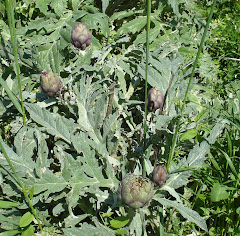
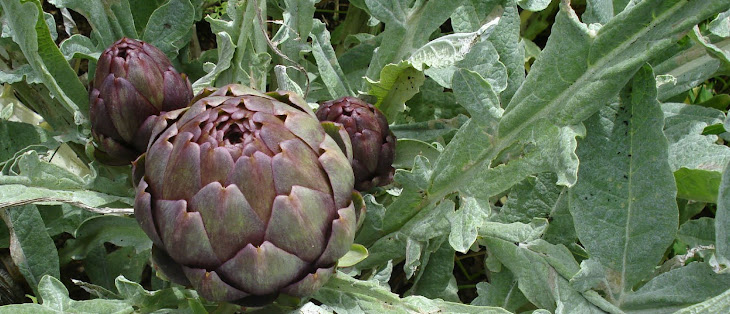
We’ve had only five artichokes so far this year and there are a few more to come before the weather gets too dry for them and the plants die back over the summer.  Today we picked three small ones and some broad beans and I cooked them together with sweet onions also from the garden.  Artichokes and broad beans do seem to go very well together and I posted a recipe a couple of years ago which was my version of a dish we’d eaten in a Greek restaurant in London.  There’s another version using dill, posted yesterday on the French-language blog En Direct d’Athènes.  Today, when I’d cooked the artichokes, beans, onions and a few garlic cloves in olive oil and white wine, I let them cool and then served them as a first course with some finely chopped fresh garlic, Greek oregano leaves, ground black pepper and a squeeze of lemon juice.  There’s nothing like the flavour of your own artichokes eaten on the day they were picked.

DSC03836

And for the future …

The little caper seedlings which I entrusted to our neighbour José to look after while we were away look fine although they’re growing very slowly.  I expected that, though.  We’ve grown them from seeds sent to me by Michelle at From Seed to Table in California.  She’s an expert caper grower and you can see her plants and some of this year’s buds here.  I think it will be a while before we can expect to harvest any buds, but it will be worth the wait and I’m very excited about growing them from seed.

DSC03829 DSC03830

Some of the Italian and Croatian caper seedlings we’ve managed to grow.  Soon we shall have to cut down one of each pair to allow the other to grow.  Caper plants are very sensitive to root disturbance, according to Michelle, so you can’t just pull one out or try to transplant both.  At the moment they are still in small pots and we keep them at the house on a balcony which gets the morning sun but not the hot afternoon sun, which might dry them out too much.  When they are bigger we’ll transplant them to large terracotta plants and put them in the garden, and maybe try growing one in a wall which is their natural habitat.  By that stage they will thrive in full sun.

Thursday, 27 May 2010

Home again!

DSC03765

We’re home again after a wonderful week visiting family in Wales.  We had hot weather in Wales and we’ve returned to hot weather here.  Luckily we’d asked our neighbour to water our garden and everything has grown well while we were away, especially the tomato plants.  The lettuces we planted in between the tomato rows are ready to eat now, having benefited from the water given to the tomatoes.

DSC03794 DSC03792

There was a thunderstorm just after we arrived home yesterday evening and there is still plenty of water in the stream running down from the spring at the top of the hill.

DSC03796 DSC03768

DSC03777 DSC03778
DSC03784
The tomato and cucumber plants have start to flower, and need a lot of work, tying them to their supports and removing the sideshoots on the tomato plants.  The olive trees are covered in tiny flowers, many of which we hope will grow into olives.

The courgettes are also flowering – only male flowers so far as usual at the beginning of the season, so we made fritters with a few of them.  A delicious treat with salad leaves from the garden and a glass of rosé from the Domaine des Pascales in the village.

DSC03780 DSC03803


We’ve picked far more broad beans and mangetout peas than we can possible eat, so we’re putting a lot of them in the freezer.  Unlike some other vegetables – courgettes especially – peas and beans freeze very well.  We at some of the mangetouts, and for supper I made a chilled broad bean soup, my version of a recipe in Frank Camorra and Richard Cornish’s Movida Rustica: Spanish Traditions and Recipes.  It’s made with raw broad beans liquidised with garlic cloves, olive oil and some bread soaked in water.  I added a sweet onion because we have so many in the garden now.  After chilling, the soup is served with a garnish of cured ham, a few peeled broad beans and some herbs.  Frank Camorra suggests mint, but I used oregano because I’d forgotten to pick the mint.  Any fresh herbs would give it a good flavour.  It was wonderfully creamy and a good  first course for a hot evening.

DSC03774 DSC03808

Tuesday, 18 May 2010

Rough drafts and changing plans

DSC03677-1

We’ve almost followed the rough sketch I made a few months ago for this year’s garden, but we’ve made some changes, as you can see from the scribbles I’ve made, when plants were ready before their allotted plots had been prepared.  Almost all our vegetables are planted out and growing now.  We seemed to have no space for the chilli pepper plants, but managed to squeeze a few in here and there.  Some of the tomato plants have been blown about a bit by the wind, but they’ll recover.

Is summer coming at last?

The weather is warming up – I think I’ve said this before only to see the temperatures drop and the rain start again, but this time I think it’s real.  The garden will need watering from now until September, daily for most of that time, but there will be heat to make things grow.

DSC03668

I do like to see shade because it means there’s bright sunlight too, and I liked the shadows of these railings as I walked to the garden this morning.

DSC03671 DSC03674

The irises and the roses looked good in the sunshine too.

Sunday, 16 May 2010

Artichokes at last!

DSC03653 DSC03654
DSC03652 DSC03657

I thought we weren’t going to get any at all this year, the plants were so badly affected by the cold weather in late winter/early spring, but today I picked these two small ones.  As you can see in the photo (bottom right) they have no choke, so I just cut them in half and cooked them in olive oil and white wine, with some whole sweet onions.

Four photos of two tiny artichokes may seem a bit excessive, but I’m so pleased the plants have survived and these may be the only ones we get this year!

Thursday, 13 May 2010

Brasucade de moules

We’re very lucky that the coquillage (shellfish) van comes to the village twice a week bringing sustainably produced and delicious shellfish from Bouzigues on the Etang de Thau, a salt-water lagoon only 30 or so kilometres from here.  One of our favourite ways of eating mussels is to cook them on the barbecue in a big open pan – we use a paella pan or a Spanish sartén honda, both of which are available very cheaply in a local discount store. 

DSC03599

Today I lightly sautéed a couple of sliced garlic cloves, some sprigs of savoury and rosemary, some lardons fumés (smoked bacon pieces) and a chopped dried Espelette pepper in olive oil over the flames and then left them to infuse while we cooked some whole Spanish sweet onions which I’d just pulled out of the ground.  When the onions were done and while we were eating them as a first course, the mussels were left to open and cook over the fire.

DSC03589 DSC03592
DSC03605 DSC03596

When the mussels are cooked we just put the pan in the middle of the table for people to share, with a sprinkling of chopped fresh garlic, a squeeze of lemon juice and some crusty bread.  And a glass or two of rosé wine from the Domaine des Pascales in the village.  The sun even came out for an hour or so while we were eating!

Spring flowers and leaves

DSC03570 DSC03575
DSC03581 DSC03587

The white cistus is now in flower and one of its flowers had a yellow butterfly on it.  The mangetout peas are flowering too – such beautiful petals, as lovely as sweet peas but with the advantage of pods to eat later.  Vines have insignificant flowers so this is one plant where the leaves are more impressive, especially when the sun casts shadows of one leaf upon another.

Planting out the peppers

DSC03616

We did some work too, and planted out most of our pepper plants.  There are a few more to do tomorrow and some which we want to grow in pots outside the house.